
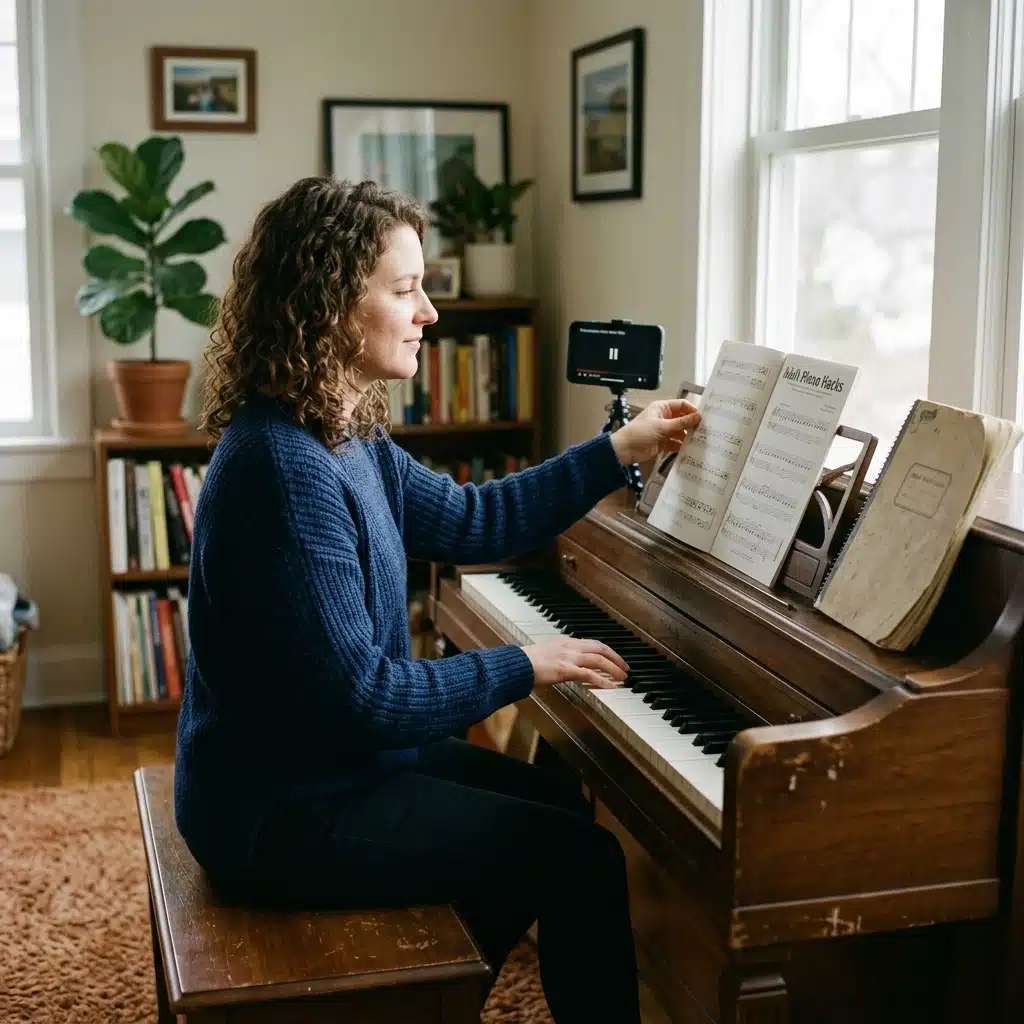
Have you ever sat down at your keyboard at 8:00 PM, intent on finally mastering that bridge in "Let It Be," only to realize at 9:30 PM that you’ve spent the entire time watching "Top 10 Hardest Piano Pieces" and gear reviews? You aren't alone. This is the "YouTube Trap," a phenomenon where the illusion of learning replaces the actual physical act of playing. For the busy adult in Tallahassee, time is the most precious commodity you own. If you are spending it consuming content rather than producing music, you are effectively stalling your own cognitive development.
At KeyNotes Piano Studio, we see this struggle frequently. Adult students often approach music with the same intellectual curiosity they bring to their careers, but music is not merely an intellectual pursuit; it is a physical and neurological discipline. Just as one cannot become proficient in high-level mathematics or a second language by simply watching others solve equations or speak, one cannot master the piano through passive observation. It requires sustained effort and a structured approach.
If you want to move beyond the "perpetual beginner" stage, you must transition from being a consumer to a practitioner. Here are seven quick hacks to help you reclaim your practice time and see real, measurable progress.
1. Treat YouTube as a Surgical Tool, Not a Buffet
The algorithm is designed to keep you watching, not to make you a better pianist. To combat this, you must treat YouTube like a surgical instrument. Before you even open your laptop or tablet, write down exactly what you are looking for.
Are you struggling with a specific chord transition? Are you looking for a particular left-hand rhythmic pattern? Search only for that. Once you find a video that addresses your specific need, watch it, then immediately close the browser. If a video does not lead to you pausing it and placing your hands on the keys within the first two minutes, it is entertainment, not education. By narrowing your focus, you protect the intrinsic value of your practice session and ensure your brain remains in "active mode."
2. Implement the 10/50 Rule
One of the greatest misconceptions in adult learning is that watching a tutorial counts as "practice time." It doesn't. To see actual growth in your neuroplasticity, you must adhere to the 10/50 rule: for every 10 minutes of video instruction you consume, you must spend 50 minutes at the keys.
This ratio ensures that the information is moving from your visual cortex into your motor cortex. When you watch a professional play, your brain recognizes the pattern, but your muscles do not yet possess the "memory" to execute it. By forcing yourself to play five times as much as you watch, you are building the discipline required to bridge the gap between theory and execution.

3. Embrace the Power of Micro-Practice Sessions
Most adults believe they need a clear, uninterrupted hour to make practicing "worth it." In reality, for the adult brain: which is often juggling professional responsibilities and family life: three 15-minute sessions are often more effective than one 45-minute marathon.
These micro-sessions prevent mental fatigue and keep the material fresh in your working memory. Keep your piano ready to play at all times. If you have to spend five minutes setting up a stand or plugging in cables, you probably won't practice. By keeping your instrument accessible, you can utilize those small windows of time: before work, during a lunch break, or while waiting for dinner: to tackle "one tiny problem." Fixing two bars of music in a focused 10-minute burst is far more productive than a sloppy run-through of an entire song.
For more on why structure beats screen time, you might find our thoughts on why piano lessons beat screen time relevant, even for adults.
4. "Zoom In" and Loop the Problem
The fastest way to hit a plateau is to play through the parts of a song you already know, only to stumble over the "hard part" and then keep going. This rewards your brain for making mistakes.
Instead, "zoom in" on the two to four measures that are causing the trip-up. Loop them. Play them hands separately, then hands together at a tempo that feels painfully slow. Use "thinking pauses" where you stop before the difficult chord change, mentally visualize the fingering, and then execute. Once you can play that loop perfectly five times in a row, you have earned the right to move on. This level of sustained effort is what differentiates a hobbyist from someone who is truly mastering an instrument.
5. Master the "Chord-First" Architecture
Adults have a distinct advantage over children: a more developed sense of logic and pattern recognition. While children often learn through rote repetition of melodies, adults can accelerate their progress by learning the "architecture" of music: chords.
Instead of trying to decode every single note on a staff for a new pop song, learn the primary chords in the key. If you understand the relationship between the C, F, and G chords, you can play hundreds of songs almost instantly. This "chord-first" approach provides immediate gratification and builds a foundation for music theory that is as rigorous as any academic subject. At KeyNotes, we emphasize this structural understanding because it empowers students to become creators, not just mimics.

6. Rotate Your Skills to Avoid Stagnation
The cerebral cortex thrives on variety within a structured framework. If you spend your entire practice time on one song, you will eventually experience diminishing returns. A balanced 30-minute practice session should look like this:
- 5 Minutes – Technique: Scales or chord drills to warm up the physical mechanism.
- 15 Minutes – Repertoire: Working on your "challenge" piece using the looping method mentioned above.
- 5 Minutes – Sight Reading or Ear Training: Challenging your brain to translate visual symbols to sound or vice versa.
- 5 Minutes – Free Play: Improvisation or playing something you already know well to build confidence.
This rotation ensures that you are developing as a "whole musician." If you find your progress has stalled, it may be because you’ve neglected one of these pillars. You can check out our guide on 7 mistakes you’re making with adult piano lessons to see if you’ve fallen into other common traps.
7. Build a Professional Feedback Loop
The biggest limitation of YouTube is that it cannot see you. It cannot tell you that your wrists are too tense, that your fingering is inefficient, or that your rhythm is slightly "swung" when it should be straight. Without a feedback loop, you are essentially practicing your mistakes.
While recording yourself on your phone is a helpful start, nothing replaces the objective eye of a professional instructor. An instructor provides the "why" behind the "how." They can identify the specific mechanical issue that is holding you back and provide a customized solution that no algorithm can generate. Whether you are taking lessons in-person in Tallahassee or engaging in online music lessons, having a mentor is the single most effective "hack" for long-term success.

Why the Human Element Matters
At KeyNotes Piano Studio, we believe that learning an instrument is one of the most profound ways to develop character and grit. It requires a level of discipline that is increasingly rare in our "on-demand" culture. While YouTube is a fantastic secondary resource for finding a new song or seeing a different perspective on a technique, it lacks the accountability and personalized curriculum necessary for true mastery.
If you are a busy adult in Tallahassee feeling stuck in your progress, perhaps it is time to step away from the screen and into a professional environment. Whether you are looking for the best digital piano for your home or you are ready to break through a persistent practice plateau, we are here to help you turn those "wasted YouTube hours" into real musical skill.
Music is a lifelong journey. Don't let the algorithm dictate your pace. Take control of your practice, use these hacks to maximize your efficiency, and remember that the most important part of playing the piano isn't what you watch: it's what you do with your hands once the screen goes dark.
