Have you ever walked past a piano, watched your child reach up to the keys, and braced yourself for the inevitable discordant "thump" that follows? We’ve all been there. But what if that "thump" was the first step toward a lifetime of cognitive development, discipline, and, dare I say, actual music?
At KeyNotes Piano Studio, we see this transition every day. Moving a child from "randomly hitting things" to "purposefully creating sound" is one of the most rewarding journeys a parent can witness. However, the world of music education can feel a bit like a foreign country where you don’t speak the language. If you're wondering where to start, you aren't alone. Piano isn't just a hobby; it is a fundamental tool for building a child’s brain, comparable in importance to Math or History, but with the added benefit of a much cooler soundtrack.
The Foundation: It Starts with the Sit
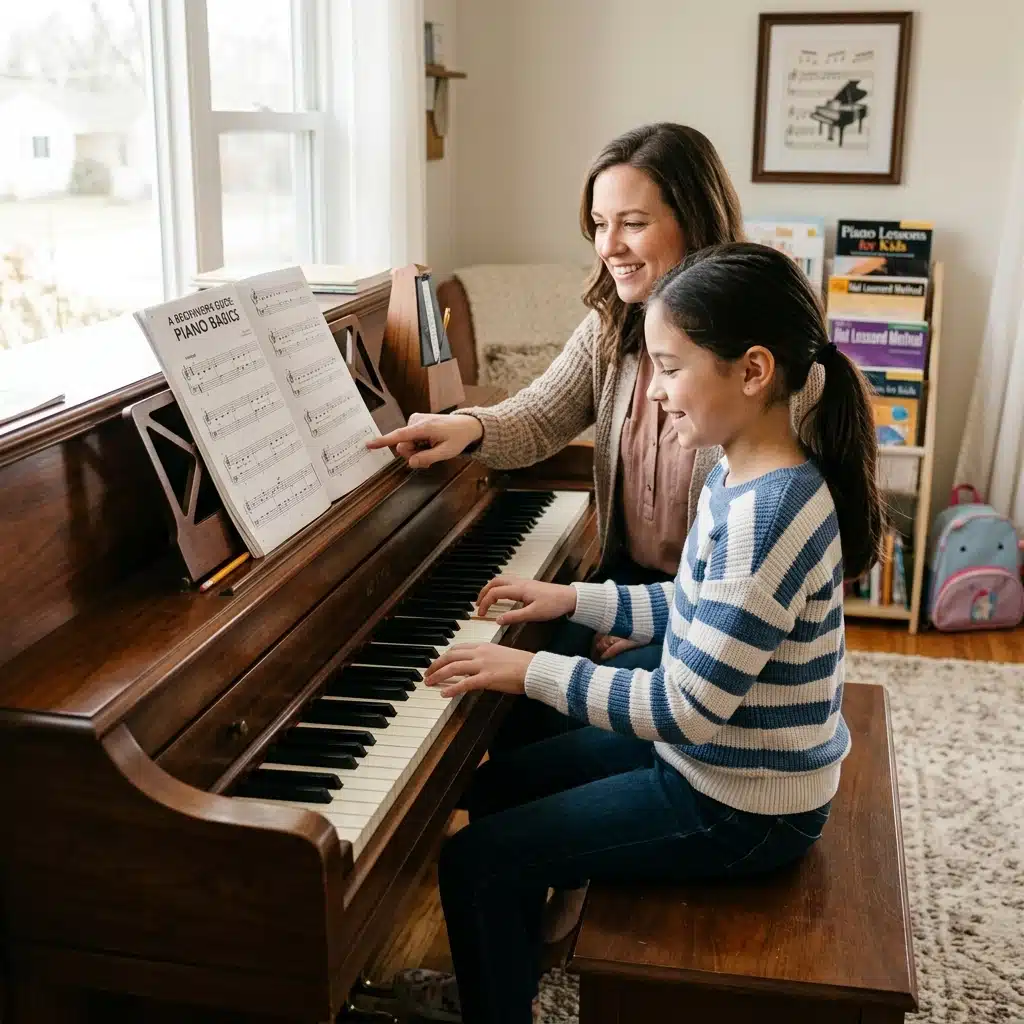
Before a single note is played, we have to talk about the "throne." Yes, the piano bench. You wouldn't let your child learn to write while hanging upside down from a tree, so why let them learn piano while slouching like a tired marshmallow?
Posture is the secret sauce of piano playing. It’s about more than just looking professional; it’s about physics and ergonomics. When a child sits correctly, they have the leverage and freedom of movement to play across the entire keyboard.
- The "L" Shape: Feet should be flat on the floor (or on a footstool if they’re still on the shorter side). Knees should be slightly under the keyboard.
- The Bench Distance: They should sit on the front half of the bench, far enough back that their elbows are slightly in front of their torso.
- The Straight Back: Imagine a string pulling them up from the top of their head. Not stiff like a statue, but tall and alert.
At KeyNotes, we make this a game. We call it "The Royal Seat." When kids feel like they are in a position of power, they take the instrument more seriously. Plus, good posture prevents the neck strain that comes from the "screen slouch" we see so often these days. In fact, starting early matters, as it builds these physical habits before the bad ones can take root.

The "Secret Claw": Hand Position 101
Once the "sit" is mastered, we look at the hands. If you watch a toddler play piano, they usually use one finger to poke the keys like they’re trying to kill a bug. We want to move away from the "poker" and toward the "player."
We teach the "Bubble Hand" or the "Claw." Ask your child to hold a tennis ball or an orange. That curve in the hand? That is exactly how they should play the piano.
Why does this matter?
- Speed: Curved fingers move faster than flat ones.
- Strength: The tips of the fingers are stronger than the pads when supported by a curved arch.
- Control: It allows for a more nuanced touch, which is the difference between a loud "bang" and a soft, melodic tone.
If you’re looking for piano lessons for kids, checking how a teacher addresses hand position in the first five minutes tells you a lot. At KeyNotes, we use fun analogies: like pretending there’s a tiny, sleeping ladybug inside their palm that they can’t squish. It keeps the mood light while instilling high-level technical skills.
Navigating the Map: The Keyboard Layout
The piano keyboard looks like a sea of white and black sticks to the uninitiated. But to a musician, it’s a perfectly organized map.
The first thing every kid learns is the pattern of the black keys: Groups of two and groups of three. This is the "GPS" of the piano.
- Find the group of two black keys. The white key directly to the left is C.
- Find the group of three black keys. The white key directly to the left is F.
Mastering "Middle C" is the first major milestone. It’s the home base. Once a child realizes that the alphabet only goes from A to G on the piano before repeating, the "daunting" instrument suddenly feels manageable. This isn't just rote memorization; it's developing spatial awareness and pattern recognition, skills that translate directly to higher-level mathematics.

Why "Fun" is a Requirement, Not an Option
Here is a hard truth: if a child isn't having fun, they will eventually quit. You can have the best intentions in the world, but if piano feels like "Math Homework: The Musical," the keyboard will eventually become a very expensive shelf for dust.
At KeyNotes Piano Studio in Tallahassee, we prioritize engagement. We don't just sit and drill scales for 30 minutes. We play games. We use rhythm cards. We let them explore. We even discuss how gamified apps can be a supplement: though never a replacement: for the human connection of a real teacher.
The goal is to foster intrinsic value. We want the child to want to play because it feels good to create something. When a student masters their first five-note song, the look of confidence on their face is worth more than any trophy.
The Tallahassee Advantage: In-Person vs. The Screen
We live in a world where you can learn anything on YouTube. So, why bother driving to a studio in Tallahassee?
Imagine trying to learn to ride a bike by watching a video. You can see how it’s done, but the video can’t catch you when you wobble. A screen can't see that your child’s pinky finger is collapsing or that they are holding their breath while they play.
In-person lessons provide:
- Immediate Correction: We stop bad habits before they become muscle memory.
- Emotional Support: A teacher can sense when a student is frustrated and pivot the lesson to keep them encouraged.
- Social Interaction: Being part of a studio like KeyNotes Piano Studio means being part of a community.
While apps are great for "extra credit," the sustained effort required for true mastery is almost always cultivated through a face-to-face relationship with a mentor.

The Long-Term ROI: Brains and Character
As a parent, you aren't just paying for piano lessons; you are investing in your child's cerebral cortex.
Research has shown that music instruction improves executive function: the ability to plan, focus, and multitask. It forces the left and right hemispheres of the brain to communicate at high speeds. This is why many of the world's top scientists and engineers are also musicians.
Furthermore, piano teaches discipline. In an era of instant gratification, piano is a slow burn. You don't get good in a day. You get good through "micro-wins" over months and years. This teaches a child that struggle is just a precursor to success. It moves them from a "fixed mindset" to a "growth mindset."
Common Obstacles (And How We Smash Them)
"But my kid won't practice!"
This is the number one concern we hear. The "Practice War" is a staple of many households. Our advice? Keep it short.
For a beginner, ten minutes of focused practice five days a week is infinitely better than an hour-long "shame session" on Sunday night. At KeyNotes, we help parents set up realistic goals so that practice feels like a victory lap, not a chore. We focus on the quality of the "sit" and the "claw," ensuring that even ten minutes is highly productive.

Final Thoughts for the Interested Parent
If you’re in Tallahassee and looking to give your child a gift that won't be broken or forgotten by next Christmas, consider the piano. It is the "gateway" instrument. Whether they eventually want to move into singing lessons or even composition, the foundation they build here will support them forever.
At KeyNotes Piano Studio, we believe every child has a musical voice. Our job is just to help them find the right keys to express it. We make the first steps engaging, stress-free, and: most importantly: fun for the whole family.
Ready to trade the "thumps" for actual tunes? We’re here to help you start the journey. Let’s make some music together!

