
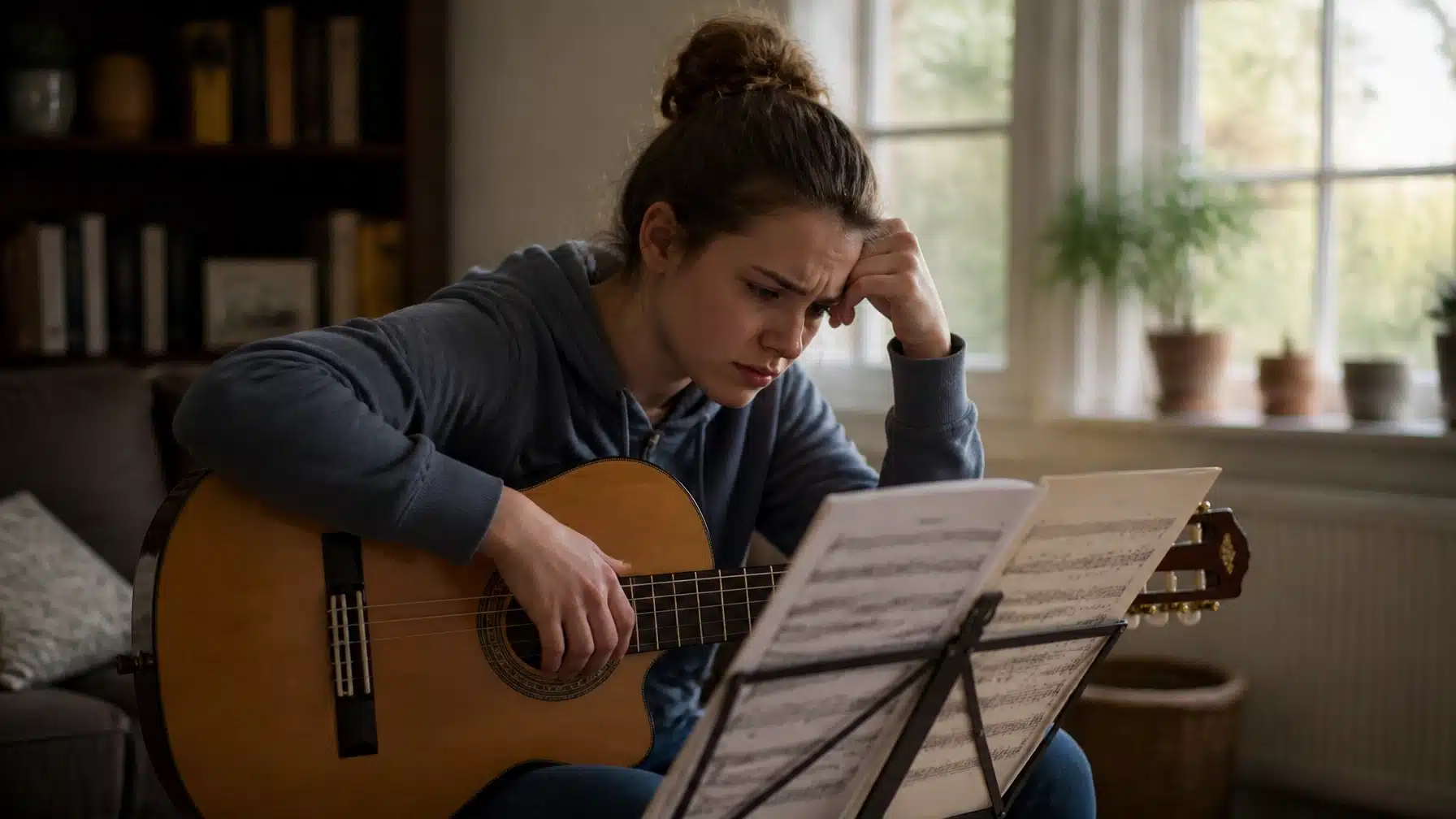
Have you ever sat down at your instrument: whether it’s the piano, a guitar, or simply warming up your vocal cords: and realized forty-five minutes have passed, yet you sound exactly the same as you did when you started? It’s a frustrating, circular experience. You’re putting in the time, you’re "doing the work," and yet the breakthrough remains stubbornly out of reach. You might start to wonder: Is it me? Am I just not "musical" enough?
Let’s stop that train of thought right there. The issue isn't your talent; it's your process. Practicing in a vacuum is like trying to navigate the winding streets of Tallahassee without a GPS: you’ll eventually move, but you’ll likely end up in a cul-de-sac when you were aiming for the Capitol.
Solo practice is a vital part of musicianship, but without expert intervention, it often devolves into a series of bad habits disguised as progress. Here are ten reasons why your solo practice is hitting a wall and how professional guidance can turn that "stuck" feeling into a massive leap forward.
1. The "Infinite Loop" of Mindless Repetition
The most common pitfall in solo practice is the "play-through" trap. You start at measure one, play until you hit a mistake, stumble through it, and keep going to the end. Then, you do it again.
This isn't practicing; this is just repeating a mistake until it becomes permanent. When you practice without a guide, your cerebral cortex begins to hardwire those errors. At KeyNotes Piano Studio, we teach our students how to deconstruct a piece, isolating the "problem cells" rather than just playing the whole body of the work. We move from mindless repetition to deliberate practice, which is the only way to actually improve.
2. You’ve Developed "Blind Spots" in Your Technique
We cannot see what we cannot see. If your wrist is too tense during a difficult piano passage, or your vocal placement is slightly too "throaty," you might not notice until the pain starts or the sound thins out.
An expert instructor acts as a high-definition mirror. In our teaching philosophy, we emphasize the physical mechanics of playing. A slight adjustment to your posture or finger arch can be the difference between a lifetime of fluid playing and a premature end due to repetitive strain. You can’t fix a technical flaw you don't know exists.

3. The "Good Enough" Plateau
When you practice alone, you are the judge, the jury, and the executioner of your own progress. The problem is that we are often too easy on ourselves (or occasionally, unnecessarily harsh). We hit a level of "good enough" where the song is recognizable, and we stop pushing.
Expert guidance provides a necessary "push." We help you see that the intrinsic value of a piece of music lies in the nuances: the phrasing, the dynamics, and the emotional arc. Without a teacher to say, "That was correct, now let’s make it beautiful," most students plateau far below their actual potential.
4. Lack of Academic Rigor
Would you expect to master Calculus by just "messing around" with numbers? Probably not. Yet, many people treat music as a purely intuitive hobby. In reality, music is as much a formal discipline as Mathematics or History.
If you don't understand the underlying music theory: the "why" behind the notes: you are essentially just memorizing a sequence of finger movements. Our lessons for adults and children alike integrate theory as a core component. When you understand the logic of the key signature or the chord progression, your ability to memorize and interpret music skyrockets.
5. You’re Using the Wrong "Language"
Music is a language, and like any language, it has syntax and grammar. If you are teaching yourself, you might be "speaking" with a heavy accent that makes the music sound clunky or unrefined.
An instructor helps you understand musical "sentences." We look at how a melody moves and where it breathes. This level of sophistication is rarely achieved through solo YouTube tutorials or apps. It requires a human ear to catch the subtle inflections that make a performance sound professional rather than robotic.

6. The Motivation Mirage
Solo practice relies entirely on your internal willpower. Some days that willpower is a roaring fire; other days, it’s a damp match.
The simple act of having a weekly appointment at our Tallahassee studio creates a level of accountability that transforms your relationship with your instrument. It’s much harder to skip your scales when you know your instructor is going to ask about them on Monday. This external structure helps build the discipline necessary for long-term success, far beyond the initial "honeymoon phase" of learning a new hobby.
7. Repertoire Rut
Left to our own devices, we tend to choose music that is either way too hard (leading to frustration) or way too easy (leading to boredom).
We curate a curriculum that hits the "Goldilocks zone": challenging enough to stimulate growth but structured enough to ensure victory. Whether it’s piano, guitar, or voice, we introduce students to genres and styles they might never have discovered on their own, expanding their musical palette and keeping the spark alive.
8. Misunderstanding the "Long-Term" Outlook
In an era of instant gratification, solo learners often quit when they don't see results in three weeks. They view music as a series of "hacks" rather than a sustained effort toward mastery.
A mentor provides perspective. We’ve seen the journey a thousand times. We know that a "bad" week of practice is often just the prelude to a major cognitive breakthrough. We help you focus on the development of the whole person: building confidence and character: rather than just checking a box on a song list.

9. Performance Isolation
Music is meant to be shared. If you only ever play for your bedroom walls, you’re missing out on the most vital part of the experience.
Solo practitioners often struggle with intense anxiety when they finally do play for someone else because they haven't built the "performance muscle." At KeyNotes Piano Studio, we provide performance opportunities in a supportive environment. This takes the music off the page and brings it into the real world, giving your practice a tangible, exciting goal.
10. The Myth of the "Self-Taught Genius"
We love the story of the prodigy who learned in a garage, but those stories are outliers for a reason. Even the greats had mentors. Behind every "natural" talent is usually a teacher who provided the foundational structure they needed to flourish.
Expert guidance isn't a crutch; it's a catalyst. It speeds up your progress, prevents injury, and ensures that the time you spend practicing actually yields results. Don't believe us? Check out our satisfied customers to see the difference professional instruction makes.

The Tallahassee Breakthrough
If you’re in Tallahassee and feeling like your musical journey has stalled, it’s time to stop the solo struggle. Whether you're interested in the complex architecture of a classical piano piece, the rhythmic drive of the guitar, or the raw emotional power of the human voice, we are here to provide the map.
Learning an instrument is one of the most rewarding challenges a human can undertake. It sharpens the mind, soothes the soul, and provides a sense of accomplishment that few other activities can match. But you don't have to do it alone.
Ready to break through the plateau?
Explore about the instructor to see how our expertise can fix your practice routine fast. Let’s turn those frustrated practice sessions into the highlights of your week.
Your instrument is waiting. Let's make sure you're giving it the practice it deserves.
