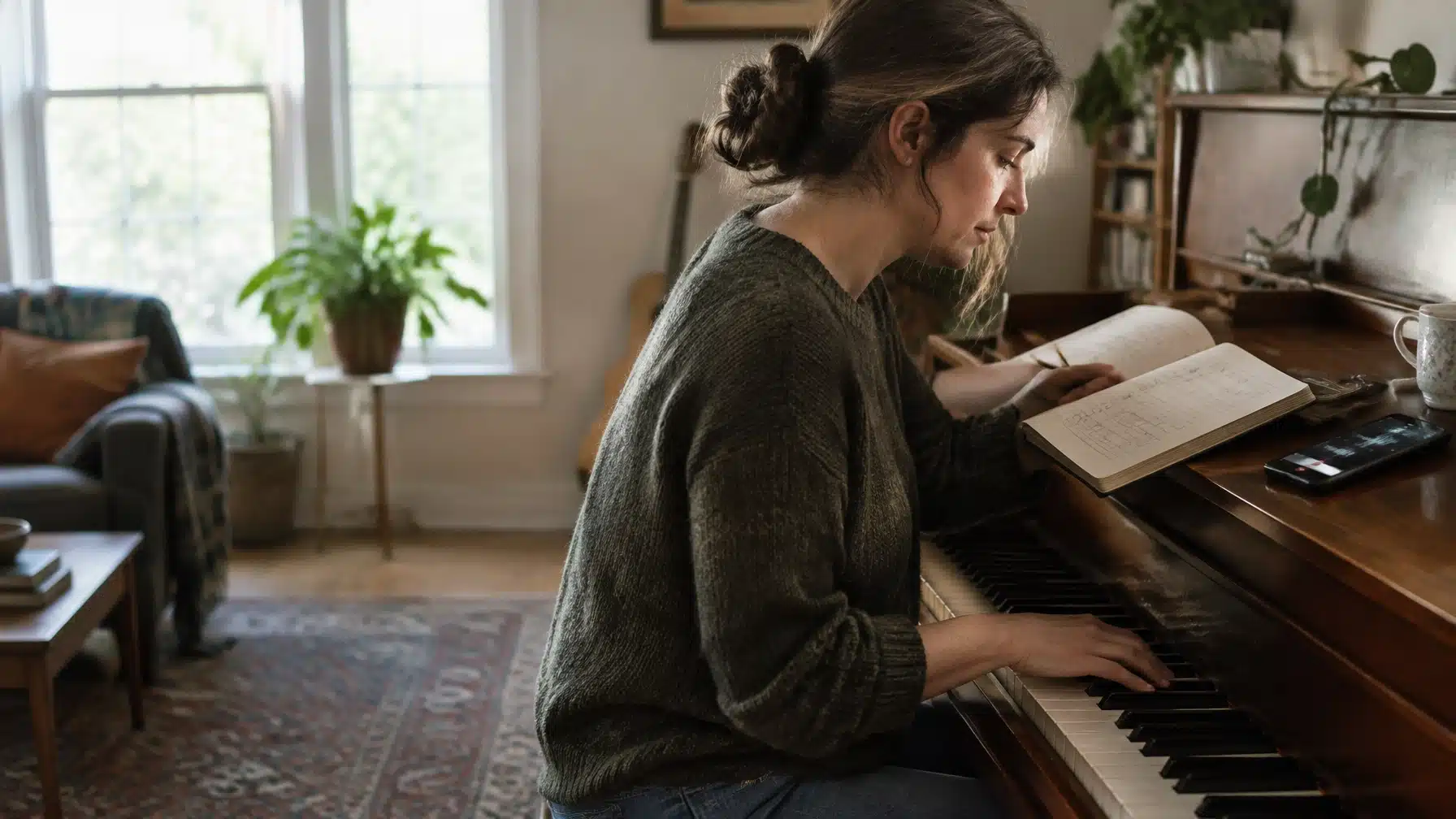
Have you ever played a few notes on your instrument and thought, “That sounds like the beginning of something”? You don’t need to know what every note is called before you follow that thought. You can begin composing with the musical knowledge you already have: by listening, experimenting, and capturing ideas before they disappear.
Music theory can help you understand and communicate what you create, but it is not a gate you must pass through first. Think of theory as a vocabulary for describing musical choices. You can start making those choices now, then learn the terms as they become useful.
Start with a small musical idea, not a whole song
A first composition does not have to be a complete, polished song. Begin with one small idea: a melody you can hum, a guitar rhythm, a chord pattern, a lyric, or a mood you want to express. Record it on your phone or write a few notes in a notebook. A rough recording is useful; it does not need to sound professional.
The BBC’s guide to starting a composition recommends starting with a few notes or bars, trying alternatives, and developing the ideas that interest you. That is a practical approach for beginners: experiment first, evaluate later.
If you play piano, try a short phrase and repeat it with a different ending. If you play guitar, find a rhythmic pattern and hum over it. If you sing, improvise a melody on a comfortable vowel and record it before adding words.

A simple exercise for your first piece
Set aside 15 to 20 minutes. The goal is not perfection. It is to make a small, complete musical idea that you can revisit.
- Choose a feeling or image. It could be a rainy afternoon, excitement before a trip, or a character in a story.
- Make a short motif. Hum or play a phrase of two to four bars, or simply improvise until a short idea catches your attention.
- Record it. Use a phone, voice memo, or recording app. If you can’t notate the melody yet, a recording preserves it.
- Repeat and vary it. Play the motif again, changing the rhythm, the last note, the volume, or the instrument.
- Add a contrasting idea. If your first phrase feels calm and low, try a second phrase that is higher, more energetic, or more spacious.
- Listen back and choose. Keep what feels interesting. Set aside what doesn’t. You can always return to discarded ideas.
The aim is to create a beginning and a response, not necessarily a full song. Finishing a small draft teaches more than waiting for inspiration to deliver a flawless piece.
What do music composition lessons actually teach?
Good music composition lessons help you turn musical instincts into choices you can repeat and develop. At KeyNotes Piano Studio, composition study can explore melody, harmony, form, style, and arranging, with the focus shaped around the student’s interests. A beginner may work on a short piano piece or song, while another student may want to explore a film-style cue or a more formal score.
Lessons can also help you learn theory in context. Instead of memorizing chord names in isolation, you can discover how a chord supports your melody. Instead of studying musical form as a diagram, you can hear how repetition and contrast help a piece make sense. Notation and music software can be introduced when they serve your goals; they don’t have to be the starting point.
Composition is not separate from performing. It can deepen your understanding of music you already play, because you begin noticing how composers shape a phrase, create tension, and bring an idea back. That calls for the same attention, discipline, and sustained effort you would bring to learning an instrument.
Math teaches us to recognize patterns and relationships; composition puts pattern and proportion to work in sound. History asks us to understand choices and context; listening closely to music can open a similar inquiry into style and tradition. Music does not replace those subjects. It deserves the same seriousness as a way of learning, thinking, and communicating.
Theory is useful, but it doesn’t have to come first
It’s common to assume that composing requires a strong grasp of notation, scales, and chord progressions before you can write anything worthwhile. That belief can stop beginners before they start. You do not need to know every rule to make a musical choice.
You might discover by ear that one chord feels settled and another makes you want to hear what comes next. Later, learning terms such as “tonic” or “dominant” can help explain that effect. You might find a melody on guitar before you can write it down. Later, notation can make the idea easier to share with another musician.
An instructor can introduce concepts when a real musical question arises: How can this melody resolve? Why does this chord fit? How do I notate the rhythm so someone else can play it? This makes theory a tool for understanding, not a test of whether you are “allowed” to create.
How a teacher helps you move beyond the blank page
Starting alone can be freeing, but it can also be frustrating. You may have a promising phrase and then get stuck repeating it without knowing how to build a larger piece. A teacher can offer a practical next step: try a variation, add a contrasting section, adjust the rhythm, or find a chord pattern that supports the idea.
In a one-to-one lesson, the instructor can listen to what you are trying to express and help you refine it without taking ownership of the music. For a child or teen, that guidance can help channel imagination into a project with manageable steps. For an adult learner, it can connect existing instrumental skills with the goal of creating something original.

At KeyNotes Piano Studio, music composition lessons are available in person in Tallahassee and through online instruction. Lessons can be a standalone course or an addition to piano study. In-person lessons provide live, face-to-face guidance; online music lessons offer another way to work with an instructor when distance or scheduling makes that more practical.
Make room for revision, and for your own voice
Your first version is a starting point, not a verdict on your ability. Listen back and ask specific questions: Is there a part I want to hear again? Does the second phrase feel different from the first? Is the rhythm comfortable to play or sing? Would a shorter ending make the idea clearer?
This kind of revision builds more than technical skill. It practices patience, flexible thinking, and confidence: the willingness to try, listen, adjust, and try again. Composers are not people who never make awkward drafts. They are people who learn to work with drafts.
Research on music-making and cognition is active, but it is wise not to promise that composition will produce a particular academic or health outcome. A 2025 systematic review of music-making interventions in older adults found a small and varied body of evidence, with limitations across the included studies. The strongest everyday reason to compose is simpler: it is a meaningful way to engage with sound, express ideas, and develop a skill through practice.

Your first piece can be small, and still matter
You do not need a theory credential, expensive software, or a fully formed song to begin. Start with a phrase. Record it. Try a variation. Keep what speaks to you, and learn the vocabulary that helps you take the next step.
If you or your child would like support turning musical ideas into a finished piece, explore composition lessons at KeyNotes Piano Studio or contact the studio. The first goal is not to write a masterpiece. It is to begin, and to discover what your musical idea can become.
