
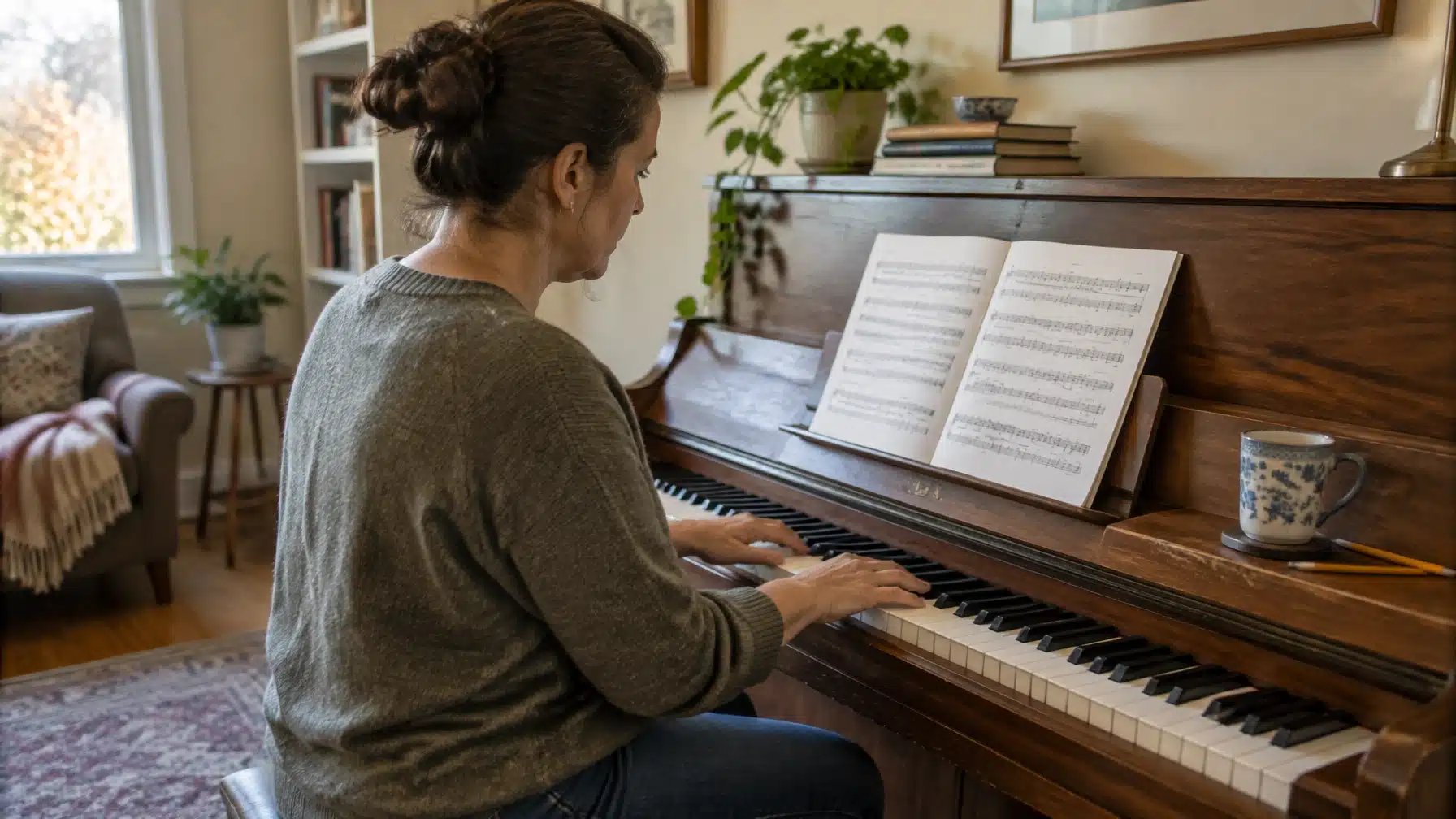
Does the idea of learning piano sound wonderful, until you picture adding another hour to an already full day? If you’re a parent fitting music in around family life, a professional with a packed calendar, or a retiree with plenty of interests competing for attention, you may be wondering whether short practice sessions are worth it.
They are. Fifteen focused minutes can help you build a consistent routine and make meaningful progress on a specific musical goal. They are not a magic shortcut, and they will not cover everything a longer session can. The advantage is that a short, repeatable plan is often more realistic than waiting for an occasional free hour.
Why a regular 15 minutes can beat an occasional marathon
Practice is not simply time spent at the keyboard. It is time spent noticing, deciding, trying, listening, and adjusting. When you sit down with a clear goal, even a short session can give your brain a useful opportunity to work on one skill.
Research on motor learning and music practice generally supports distributing practice across sessions rather than relying only on one long, infrequent block. Some studies with novice keyboard players have found benefits from practice spread across days, while other piano studies have found no clear advantage from adding short pauses between repetitions. The takeaway is not that a specific schedule is guaranteed to work for everyone. It is that frequent, attentive practice is a practical way to revisit a skill over time, while the ideal spacing depends on the learner, the task, and how progress is measured.
For an accessible look at the evidence, see the piano-learning study on spacing between repetitions and research on distributed practice and skill learning in musicians. These studies do not establish that exactly 15 minutes is optimal. They support a sensible habit: practice regularly, focus on a manageable task, and check whether it is easier to recall later, not just whether it felt smooth after repeating it many times in one sitting.
This is much like learning in other subjects. Math requires regular work with specific problems; history asks you to revisit names, events, and connections. Piano deserves the same intentional attention, not because it replaces academic study, but because learning music asks you to develop listening, coordination, patience, and musical understanding together.
A practical 15-minute piano practice plan
Set a timer if it helps you stay on track. Keep the plan flexible, but give each part a purpose.
Minutes 1–2: Warm up and review
Begin with a relaxed posture and easy movement. Play a simple five-finger pattern, a familiar scale, or a short exercise your teacher has assigned. Then briefly revisit something from yesterday.
The goal is not speed. Listen for an even tone and comfortable movement. If your hands feel tense, slow down and reset.
Minutes 3–7: Focus on one skill
Choose one small challenge, not the whole piece. It might be a transition between two measures, a rhythm, a fingering change, or coordinating hands together.
Try this sequence:
- Play only the difficult notes or measures.
- Slow down enough to play accurately.
- Repeat with a short pause between attempts.
- Ask yourself what changed and what still needs attention.
If you keep making the same mistake, do not simply repeat it faster. Reduce the passage, check the notes and fingering, and make the task easier until you can practice it correctly.
Minutes 8–12: Work on repertoire
Apply your focus to the piece you are learning. Play a short section, then connect it to the passage before or after it. Pay attention to rhythm, dynamics, and phrasing, not just the notes.
If the piece is new, hands-separate practice may help. If you already know the notes, try to shape a phrase or make the rhythm steadier. A few intentional measures can be more useful than rushing through the entire piece.
Minutes 13–15: Play for pleasure
Finish with music you enjoy. It might be a favorite passage, a simple tune by ear, or a small improvisation using notes you know. You can also replay something that felt satisfying during the session.
This final portion matters. Piano is not only a sequence of problems to solve. Musical play helps keep curiosity and intrinsic value in the routine, especially on busy days when progress feels slow.

What 15 minutes can, and cannot, do
A daily quarter-hour can support steady contact with the instrument, help you strengthen a specific passage, and make practice easier to fit into everyday life. Over weeks and months, those small sessions add up to many opportunities to listen, correct, and try again.
But 15 minutes is not a promise of rapid mastery. It may not be enough to work deeply on several pieces, technique, sight-reading, and theory in one sitting. Some goals require a longer session, and some days you may need extra time to understand new material. The aim is not to force every part of piano study into a tiny window. It is to make a short session count when that is what your schedule allows.
If you have more time, continue. If you do not, finish the planned session without guilt. A consistent 15-minute routine can be a strong starting point; as your focus and schedule allow, you can add a second brief session or extend your practice.
Common practice mistakes beginners can avoid
Playing a piece from beginning to end every time. It feels productive, but it can leave the hardest passage under-practiced. Isolate a short section, work on it, then reconnect it to the surrounding music.
Repeating without listening. Repetition alone does not guarantee improvement. After each try, identify one detail: Was the rhythm steady? Were the notes right? Did your hands feel comfortable?
Practicing at full speed too soon. A slower tempo gives you time to think and helps avoid building mistakes into the movement. Increase speed gradually only when the passage feels reliable.
Trying to fix everything at once. Pick one priority per session. Today’s target might be rhythm; another day’s could be a smooth hand transition.
Treating a missed day as a failure. Life happens. Return to your regular short session rather than trying to “make up” the missed time with a long, tiring practice block.
How a piano teacher helps you choose the right 15 minutes
A teacher can help you decide what to practice, how to break it down, and when to move on. That guidance is especially useful for adults: you bring clear goals and life experience, but you may also bring limited practice time and questions about whether you are using it well.
At KeyNotes Piano Studio, adult students can work toward their own musical interests, from learning fundamentals to exploring favorite songs. The studio describes adult students ranging from college age to 80, and offers piano lessons for adults tailored to the learner. A lesson can clarify fingering, spot a movement that causes tension, or turn a vague practice goal into a manageable plan. That is how sustained effort becomes more effective: not by demanding perfection, but by helping you make thoughtful choices and build confidence over time.

For adult beginners looking for piano lessons Tallahassee can offer, in-person lessons provide a chance to work directly with a teacher at the keyboard. KeyNotes also offers online piano lessons for students who prefer to learn from home or are outside the local area.
A small routine that respects a full life
A useful practice plan should fit the person who will actually use it. Parents might choose a quiet moment after dinner; professionals may prefer a short morning session; retirees may enjoy making piano part of a relaxed daily routine. The best time is the one you can return to consistently.
Start with 15 minutes, four or five days this week. Keep one small goal in mind, and finish by noting what you want to revisit next time. Then notice what happens, not just in your playing, but in your willingness to sit down again.
If you’re ready to begin or want help shaping your routine, learn about piano lessons at KeyNotes Piano Studio or contact the studio. A short practice session is not everything piano learning requires. It is a practical, worthwhile way to begin.
