
Have you ever watched your child avoid something difficult because they are afraid of getting it wrong?
Many parents in Tallahassee recognize this pattern. A child may understand that practice is important, yet hesitate to raise a hand in class, try out for a team, or perform in front of others. The fear is not always a lack of ability. Often, it is a lack of confidence that their effort will lead somewhere.
This is where music education becomes far more than an extracurricular activity.
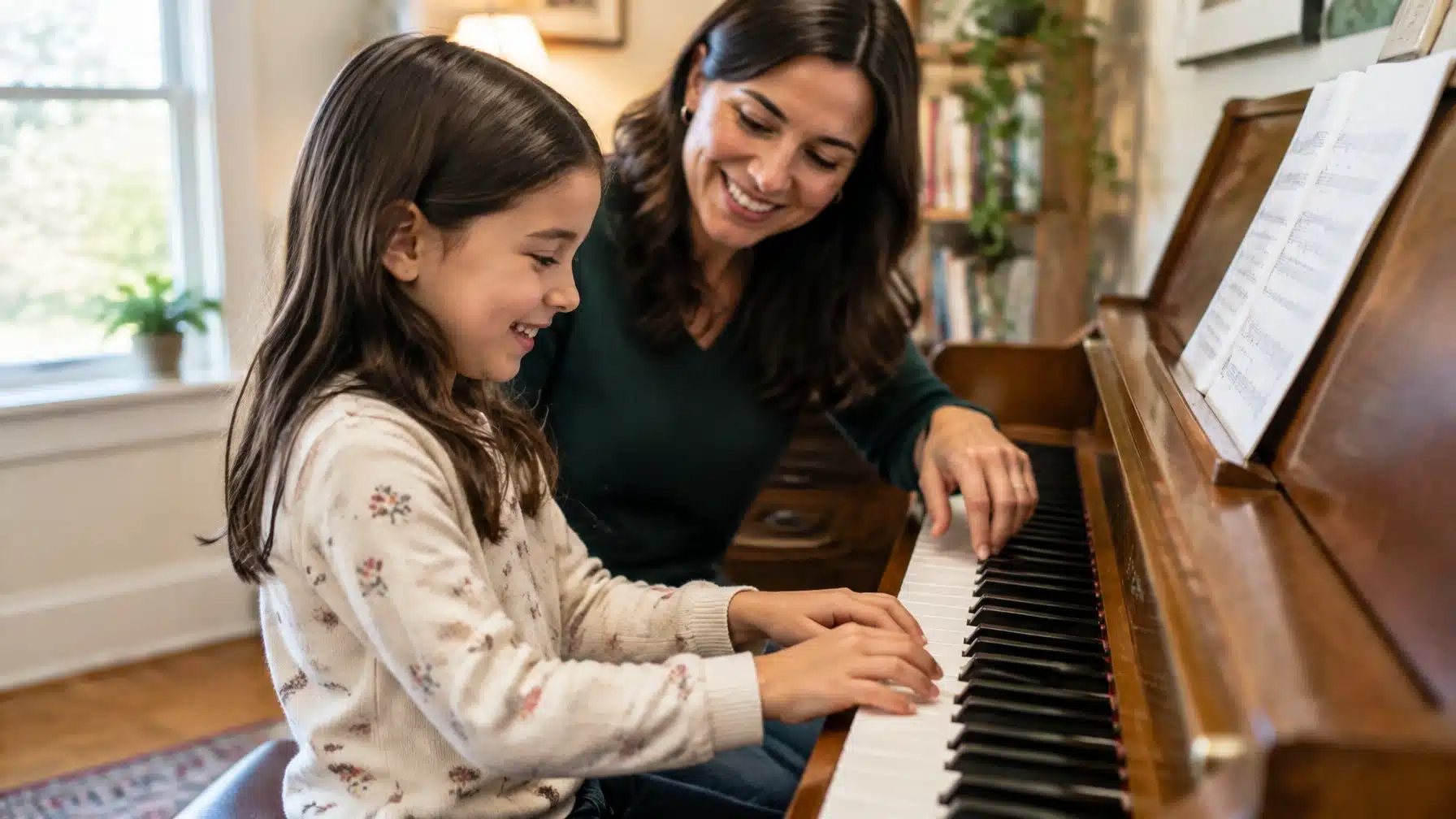
Well-structured piano lessons for kids give children repeated opportunities to attempt challenging tasks, receive precise guidance, correct mistakes, and experience genuine progress. Over time, those experiences develop confidence that is earned rather than merely given. They also strengthen discipline, focus, self-control, working memory, cognitive flexibility, and resilience.
Music lessons should not be treated as decorative enrichment, any more than mathematics or history should be treated as optional decoration. Each subject develops a different dimension of the whole person. Mathematics trains quantitative reasoning. History develops perspective and judgment. Music trains attention, coordination, emotional expression, and sustained effort in one integrated experience.
Here are seven ways live music lessons can help children grow into more capable and confident people.
1. Visible Progress Builds Genuine Self-Confidence
Confidence does not come from constant praise. It comes from evidence.
A child who could not coordinate two hands last month but can now play a short passage has evidence that effort works. A student who once struggled to read notes but can now play a complete melody has evidence that difficult skills can become manageable.
Psychologists often refer to this as self-efficacy: the belief that one is capable of taking action and improving through effort. In music, children experience this principle every week. The teacher breaks a complex skill into achievable steps, the student practices those steps, and progress becomes audible.
That sequence matters. A child is not simply told, “You are talented.” The child discovers, “I can learn.”
This is one reason the structure of KeyNotes Piano Studio’s curriculum and lesson formats matters. Appropriate challenges create regular victories without making the work meaningless. The goal is not to remove difficulty. The goal is to make difficulty productive.
2. Mistakes Become Lessons in Resilience
What happens when a child plays the wrong note?
In a healthy music lesson, the answer is not embarrassment or defeat. The teacher helps the child identify what happened, adjust the approach, and try again. A wrong note becomes information.
That is an important emotional shift. Children learn that a mistake is not a judgment about their intelligence or worth. It is a normal part of learning.

This process develops resilience and a practical growth mindset. Students begin to understand that frustration is temporary and that improvement often requires sustained effort. They also learn self-control: pause, listen, diagnose, and respond instead of reacting impulsively.
A supportive teacher is essential here. Emotional safety does not mean lowering standards. It means maintaining high standards while making it safe for a child to miss, ask questions, and try again. That balance allows children to pursue excellence without developing a fear of failure.
3. Performance Teaches Children to Manage Nerves
A recital is not simply a chance to display technical progress. It is a structured lesson in courage.
Before performing, a child must prepare for a specific date, remember instructions, regulate nervous energy, and follow through in front of an audience. These are the same broad skills children need for presentations, auditions, classroom participation, and future professional situations.
The performance does not need to be flawless to be valuable. In fact, a child who makes a small mistake and continues may learn more about confidence than a child who performs without difficulty.
Live, in-person instruction provides meaningful opportunities for this kind of preparation through studio performance opportunities. The child is not being thrown into an intimidating situation without support. The teacher helps the student choose an appropriate piece, prepare deliberately, and understand that the goal is communication, not perfection.
The result is practical confidence: “I was nervous, but I did it.”
4. Practice Develops Discipline and Self-Control
Modern life gives children immediate stimulation. Piano offers a different lesson: some rewards must be earned gradually.
A difficult measure may require several careful repetitions. A new rhythm may need to be slowed down before it can be played at full tempo. A piece may sound uneven for days before it begins to feel natural.
This is not busywork. It is training in discipline and delayed gratification.
Children learn to direct attention toward a defined goal, resist the impulse to quit, and complete a task even when the initial excitement has faded. These habits transfer beyond the instrument. A student who learns how to divide a piece into manageable sections is also learning how to approach a long reading assignment, a science project, or a challenging athletic skill.
This does not mean piano automatically makes every child organized. It means regular, guided practice gives children a reliable environment in which organization and self-control can be developed.
Parents can support this process with a short, consistent routine rather than demanding marathon practice sessions. Ten focused minutes can be more valuable than thirty distracted minutes.
5. Music Strengthens Executive Function
Confidence and cognition are closely connected. Children feel more capable when they can focus, remember instructions, control impulses, and adapt when circumstances change.
These abilities are commonly grouped under the term executive function. They include working memory, inhibitory control, and cognitive flexibility.
Playing piano engages all three. A child must remember what comes next while playing what is happening now. They must inhibit the impulse to rush. They must shift attention between rhythm, pitch, fingering, dynamics, and musical expression.
A 2024 systematic review and meta-analysis in Frontiers in Psychology examined music training in preschool children ages three to six. Across ten studies, researchers found small but significant improvements in inhibitory control, working memory, and cognitive flexibility. The review also found that results were influenced by the duration, frequency, and structure of training. Read the study summary through PubMed.
The evidence should be interpreted responsibly. Music training is not a magic shortcut to academic success, and not every study finds identical effects. However, the research supports what experienced teachers observe: structured musical activity gives children sustained practice using the mental systems that help them learn.
6. Cognitive Flexibility Helps Children Handle Change
A confident child is not a child who always knows the answer. A confident child is willing to adjust when the first answer does not work.
Music teaches this flexibility constantly. A student may need to change fingering, slow the tempo, reinterpret a rhythm, or approach a passage from the opposite direction. The child learns that one strategy failing does not mean the entire task is impossible.
That is cognitive flexibility in action.
It is also why music deserves comparison with core academic subjects. In history, students must interpret events from multiple perspectives. In mathematics, they may solve a problem using more than one method. In piano, they learn to listen, evaluate, and adapt in real time. These are not identical skills, but they share an essential habit: the ability to revise one’s approach without abandoning the goal.
A 2019 study published in Frontiers in Psychology also reported improvements in executive function following an intensive 12-week music program for preschool children, with some benefits maintained at follow-up. Read the research.
7. A Caring Teacher Makes Confidence Sustainable
The instrument matters. The curriculum matters. But the relationship between teacher and student often determines whether the benefits endure.
Children take healthy risks when they feel seen and respected. They ask questions when they do not fear ridicule. They persist when correction feels like guidance rather than rejection.
That is the value of live, in-person piano lessons Tallahassee families can build into their child’s weekly routine. A teacher can observe posture, attention, frustration, and hesitation in real time. The teacher can adjust the pace, select music that is appropriately challenging, and respond to the child as a whole person, not merely as a collection of correct and incorrect notes.

At KeyNotes Piano Studio, this student-centered approach is reflected in the studio’s teaching philosophy. Children need structure, but they also need encouragement. They need correction, but they also need dignity. They need goals, but they also need room to develop at an individual pace.
That is how confidence becomes durable. It is built through standards, support, and repeated experiences of meaningful progress.
What Parents Should Expect Over Time
Music lessons will not eliminate every moment of shyness, frustration, or self-doubt. No serious developmental activity can make that promise. Children are still children, and confidence develops unevenly.
What lessons can provide is a consistent framework for growth:
- A clear goal to work toward.
- A teacher who offers specific feedback.
- A safe setting in which mistakes are expected.
- Regular practice in focus and self-control.
- Opportunities to share progress with others.
- Tangible evidence that sustained effort produces results.
Those habits matter whether your child becomes a professional musician, a scientist, an educator, a business owner, or simply an engaged and capable adult.

Start Building Confidence at the Piano
If you are considering piano lessons for kids this fall, begin with a first conversation and evaluation rather than waiting for your child to feel completely ready. Readiness often develops after a child experiences a welcoming lesson, not before.
KeyNotes Piano Studio offers in-person lessons in Tallahassee, including instruction in the studio and lessons in your home. The studio also serves families in surrounding areas, with options designed for different ages and learning needs.
To learn more, contact KeyNotes Piano Studio and schedule a free evaluation. The first lesson is not a test your child must pass. It is an opportunity to discover how music can strengthen confidence, character, and the capacity to keep going when something is difficult.
