
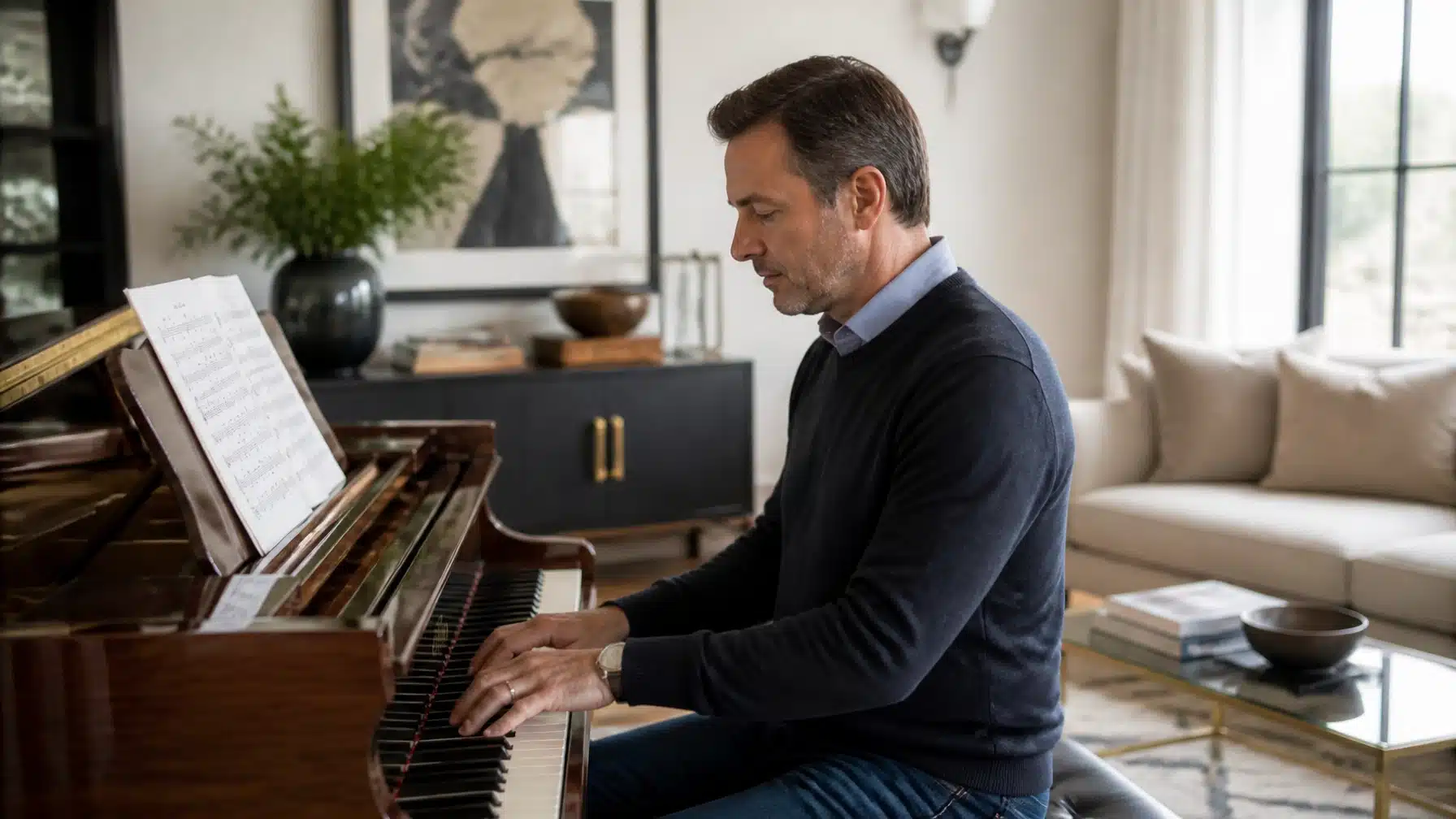
When was the last time you sat down at your piano without feeling a pang of guilt? For many of my students, the answer is "not lately." You started adult piano lessons with a heart full of ambition: visions of Chopin or Gershwin filling your living room: only to be met with the cold reality of a forty-hour workweek, family obligations, and the sheer exhaustion of modern life.
Does it feel like you’re constantly "falling behind"? Do you look at your keyboard and see a chore rather than a sanctuary?
As a mentor who has guided hundreds of adults through this exact landscape, I’m here to tell you that the "one-hour-a-day" rule is not just outdated; it’s often the very thing sabotaging your progress. In the same way that a student doesn't master Calculus by cramming once a month, or a historian doesn't understand the nuances of the Renaissance by skimming a single book, piano mastery is built on sustained effort and high-frequency, low-duration engagement.
If you can find five minutes between a Zoom call and dinner, you can build a sustainable practice routine that actually works. Here is how we transform "no time" into "noticeable progress."
The Science of the "Micro-Practice"
Before we dive into the "how," we must understand the "why." Music is not merely a hobby; it is a fundamental tool for cognitive development. When you engage in adult piano lessons, you are essentially performing a high-intensity workout for your cerebral cortex.
Research in neuroplasticity suggests that the brain responds more effectively to short, repeated stimuli than to long, infrequent sessions. This is known as "spaced repetition." By touching the keys for just five minutes every day, you are sending a consistent signal to your nervous system that these motor patterns are important. Over time, this builds improved hand-eye coordination and strengthens the neural pathways responsible for musical memory.
Think of it like this: would you expect to learn a new language by speaking it once a week for three hours? Of course not. You would learn it by speaking it for five minutes every single morning. Your piano is no different. It is a language of the soul, and fluency requires daily conversation.

Step 1: The 5-Minute "Activation" Ritual
The biggest barrier to practice isn't a lack of time; it’s friction. If you have to move a stack of mail off your piano bench, find your music books in a drawer, and hunt for a pencil, you’ve already spent three of your five minutes.
To create a sustainable routine, you must prepare your environment.
- The Visual Cue: Keep your current piece of music open on the stand.
- The Tool Kit: Have a pencil and a metronome (or a metronome app) within arm's reach.
- The "Coffee Connection": Tie your practice to an existing habit. If you drink coffee every morning, sit at the bench while your brew is dripping.
By reducing the "activation energy" required to start, you make the transition from "busy adult" to "musician" seamless. This isn't just about convenience; it’s about discipline. It’s about deciding that your creative growth is worth five minutes of intentionality.
Step 2: The Two-Minute Technical Foundation
Once you sit down, don't just "play." Practice. We begin with two minutes of technical "vegetables." This is the part where we build the raw machinery of your playing.
Choose one scale or one chord progression. This week, perhaps it’s C Major or a simple I-IV-V-I progression.
- The Goal: Precision over speed.
- The Benefit: Improved hand-eye coordination and a foundational understanding of music theory that rivals the structured logic of Mathematics.
Use a metronome. There is a profound intrinsic value in aligning your heartbeat with a steady pulse. It grounds you. If you can play a scale perfectly at 60 beats per minute, you have achieved more than someone who stumbles through a concerto at 120.

Step 3: The Three-Minute Target Focus
The remaining three minutes are for your repertoire. Here is where most adults fail: they start at the beginning of the song and play until they make a mistake, then they start over.
This is not practice; this is "noodling."
Instead, identify the one "problem spot": those two or three measures that always trip you up.
- Isolate: Play only those measures.
- Deconstruct: Play hands separately.
- Reconstruct: Play them together, slowly.
When you conquer a difficult passage, you aren't just learning a song; you are building confidence. You are proving to yourself that you can solve complex problems through focused attention. This is a life skill that translates directly from the piano bench to the boardroom.
Addressing the "Pain Point": What if I Miss a Day?
Life happens. A child gets sick, a deadline is moved up, or you simply forget. The "all-or-nothing" mentality is the enemy of sustainability. If you miss a day, don't try to "make it up" by practicing for thirty minutes the next day. That creates a cycle of "debt" that leads to burnout.
Simply return to your five minutes the following day. In the grand scheme of your musical journey: which we view as a lifelong pursuit: one day is a rounding error. The discipline lies in the return, not the perfection.
If you’re finding that solo practice is becoming a source of frustration, it might be time to look into how in-person lessons help you crush practice plateaus. Sometimes, you don't need more time; you need better direction.

The In-Person Advantage
While apps and YouTube tutorials offer a veneer of convenience, they lack the empathetic authority of a mentor. In adult piano lessons at KeyNotes Piano Studio, we don't just teach you which keys to press. We help you curate a life that includes music.
A teacher can spot the tension in your shoulders that is slowing down your progress. They can adjust your technique in real-time, ensuring that your five minutes of practice are 100% efficient. When you have a weekly appointment with a professional, your five-minute daily routine takes on a new level of importance. It becomes a preparation for a shared experience, rather than a solitary struggle.
If you're still choosing your first instrument, you might want to check out our guide on how to choose the best digital piano for adult piano lessons to ensure your home setup isn't holding you back.
A Philosophical Outlook: Developing the Whole Person
Why do we do this? Why bother with adult piano lessons when we have so many other things on our plates?
Because music is one of the few remaining places where sustained effort still yields a tangible, beautiful result. In a world of instant gratification and "hacks," the piano demands a slow, deliberate unfolding of the self.
When you commit to five minutes a day, you are practicing more than just the piano. You are practicing patience. You are practicing the art of being present. You are building a version of yourself that is capable of deep focus and aesthetic appreciation. Whether you are in Tallahassee or taking lessons online, the goal is the same: to integrate the harmony of the keyboard into the discord of daily life.

Your 5-Minute Blueprint
Let’s summarize your new, sustainable routine:
- Pre-set: Keep your music open and your bench clear.
- Minute 1-2: One scale or one chord progression with a metronome. Focus on relaxation.
- Minute 3-5: One "problem spot" from your repertoire. Slow it down until it’s perfect.
Are you ready to stop "finding time" and start "making progress"? The fastest way to get better is to stop trying to do everything at once and start doing one small thing every day.
If you’re ready to take the next step and see how professional guidance can transform your five-minute routine into a lifelong passion, we invite you to explore our adult piano lessons. Let’s make some music together.
