
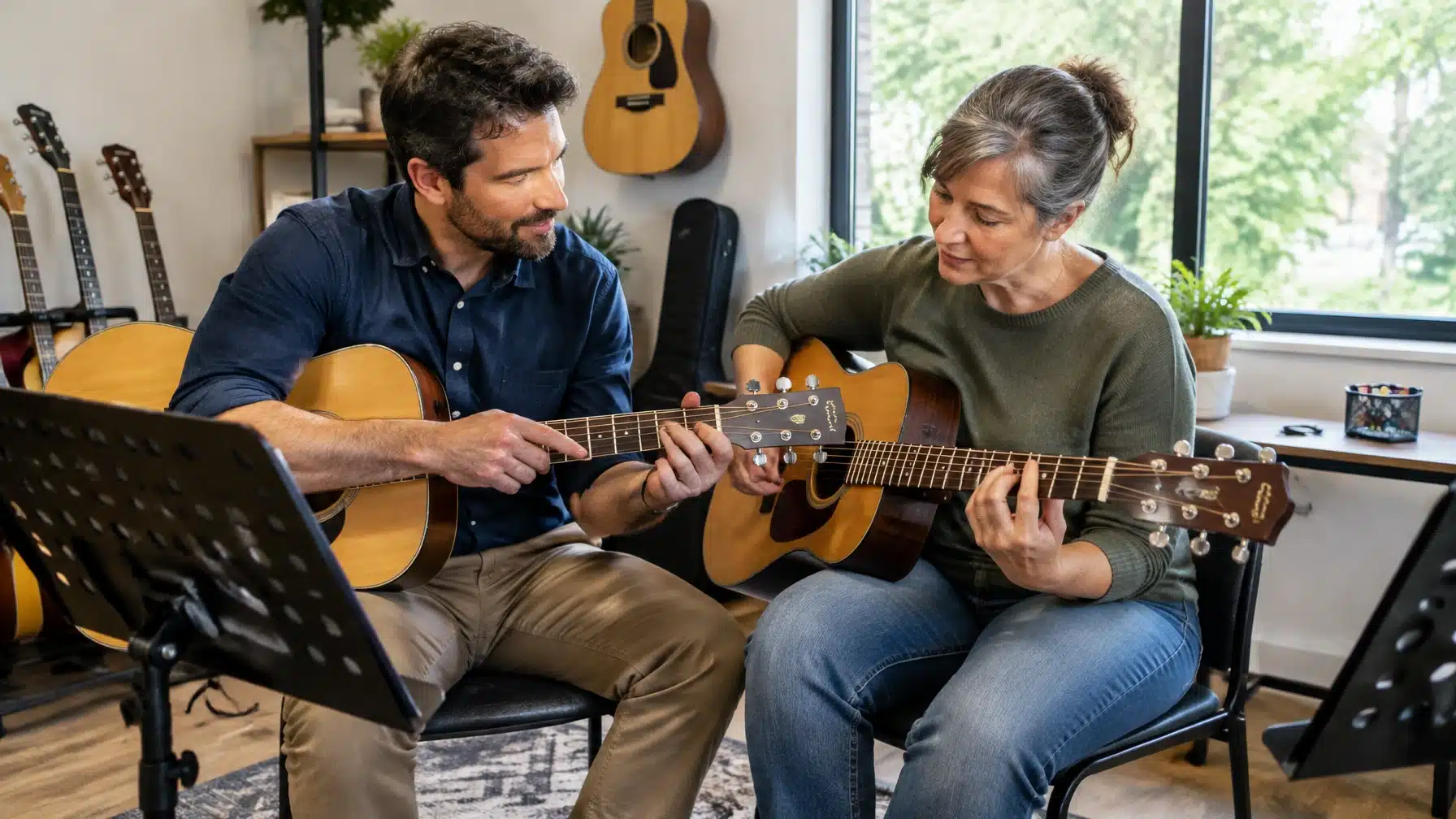
Have you ever searched for a guitar teacher, opened several promising websites, and still wondered which instructor would actually be right for you or your child?
Choosing a teacher is more important than choosing the most convenient time slot or the lowest advertised price. A guitar instructor does more than demonstrate chords. The right teacher builds your technical foundation, organizes your practice, identifies problems before they become habits, and helps you remain motivated when progress feels slow.
This is especially important for beginners. Learning guitar requires the coordination of the eyes, ears, hands, attention, and memory. It is closer to learning a language or a mathematical system than casually following a few online videos. The teacher you choose can determine whether those early challenges become satisfying milestones or discouraging obstacles.
Before booking your first lesson, ask these five questions.
1. What experience do you have teaching beginners?
A strong performer is not automatically a strong beginner teacher.
Performance experience can be valuable, but teaching requires a different set of abilities. A beginner needs someone who can explain basic concepts clearly, observe small physical details, adjust explanations, and create achievable milestones. Ask prospective guitar teachers in Tallahassee:
- How long have you taught complete beginners?
- What ages and experience levels do you typically teach?
- Do you teach acoustic, electric, classical, or multiple types of guitar?
- How do you help a student who has never read tablature or chord diagrams?
- Can you describe what a new student typically learns during the first month?
Listen for a specific answer rather than a general statement such as, “I teach all levels.” An experienced beginner teacher should be able to explain how they introduce posture, tuning, picking, fretting, rhythm, and foundational chords without overwhelming the student.
For a child, ask whether the instructor has experience maintaining focus and enthusiasm during a lesson. For an adult, ask whether the teacher can adapt instruction around prior musical experience, hand strength, physical limitations, and personal goals.
The correct question is not simply, “Can this person play guitar?” It is, “Can this person help a new guitarist understand what to do next?”
2. How are lessons structured, and what will I learn first?
A lesson should have direction. That does not mean every session must feel rigid or identical. It means the teacher should know how technical skill, music theory, repertoire, and practice fit together.
Ask what the first three to six months might include. A thoughtful progression may involve:
- Guitar anatomy and proper instrument position
- Tuning and basic maintenance
- Chord shapes and clean fretting
- Strumming patterns and steady rhythm
- Tablature or standard musical notation
- Simple songs selected around the student’s interests
- Ear training and fundamental theory
- Techniques for changing chords efficiently
Music research consistently emphasizes the value of structured, goal-directed practice with specific feedback. A large review of research on music practice identifies deliberate practice, self-regulation, metacognition, and self-efficacy as central themes in successful musical development. In practical terms, that means “practice more” is not enough. A student needs to know what to practice, how to practice it, and how to recognize improvement.

Ask the teacher how lessons are balanced. Will every session focus only on songs? Will technique be taught without musical application? Will theory be presented in a way that connects directly to the music being played?
Music theory is not an academic burden added to the guitar. It is the framework that explains why chords fit together, how rhythm is organized, and how musicians communicate. Just as mathematics gives structure to problem-solving, theory gives structure to musical understanding.
A well-designed lesson should provide both immediate enjoyment and a long-term foundation.
3. How do you handle plateaus, mistakes, and frustration?
Every serious student reaches a plateau. A chord transition stops improving. A rhythm pattern feels impossible. Fingertips become sore. A song that sounded simple suddenly seems far beyond reach.
This is not evidence that the student lacks talent. It is a normal stage of motor-skill development. The important question is how the teacher responds.
Ask:
- What do you do when a student is stuck on a technique?
- How do you adjust an exercise that is not working?
- How do you help students recover confidence after a difficult week?
- Do you break challenging material into smaller steps?
- How do you distinguish between a practice problem and a teaching problem?
An effective teacher does not respond to every difficulty by assigning more repetitions. They diagnose the cause. The student may need a slower tempo, a different fingering, a shorter practice segment, a change in posture, or a more accessible song.
This is one of the strongest advantages of live, in-person guitar lessons in Tallahassee. A teacher can see tension in the wrist, notice a collapsing finger, hear uneven rhythm, and respond immediately. A video or app may tell you whether you played the expected note. A teacher can often explain why the note was difficult to produce and what physical change will make it easier.
The best instructors build confidence through correction, not through empty praise. They make problems specific, manageable, and temporary.
4. What are your practice expectations and communication policies?
Practice is necessary, but beginners need realistic guidance. A student who is told simply to “practice every day” may spend thirty unfocused minutes repeating the same mistake.
Ask the teacher:
- How much practice do you recommend for a beginner?
- Should practice be divided into short, focused sessions?
- Will you provide written exercises or a practice plan?
- How will I know whether I am practicing correctly?
- Can students or parents ask questions between lessons?
- What is your policy for cancellations, rescheduling, and missed lessons?
Short, consistent practice is often more productive than occasional marathon sessions. A useful beginner plan might include a few minutes of technique, a focused chord or rhythm exercise, and time spent applying that skill to a song. The exact routine should reflect the student’s age, schedule, goals, and current ability.
Communication matters just as much as the practice assignment. Students should leave a lesson knowing what to work on before the next appointment. Parents should understand what their child is learning and how to support progress without becoming a second instructor.

A professional teacher also explains policies clearly before enrollment. Transparent expectations protect the student, the family, and the instructor. They also signal that the teacher takes the educational relationship seriously.
5. Do you offer live lessons, and which format is the best fit?
Ask whether lessons are offered in a dedicated studio, in the student’s home, online, or through a combination of formats.
Each format has advantages. Online lessons can be useful for students with demanding schedules or transportation challenges. In-home lessons can reduce commuting and bring instruction directly into a familiar environment. However, live in-person instruction often gives beginners the clearest feedback and the strongest sense of connection.
A studio-based lesson allows the teacher to observe the student from multiple angles, demonstrate technique at close range, and respond naturally to posture, hand position, tone, and rhythm. It also creates a focused learning environment separate from the distractions of home.
For families, ask about:
- The location and accessibility of the studio
- Safety and waiting arrangements
- Equipment students should bring
- Lesson length and scheduling options
- Whether a parent may observe or receive progress updates
For adults, consider which format will make consistent attendance most realistic. Convenience matters, but so does learning quality. The best format is the one that supports sustained effort rather than making lessons easy to postpone.
At KeyNotes Piano Studio, students in Tallahassee and surrounding areas can explore flexible lesson options, including guitar lessons, instruction in the studio, lessons in the home, and online lessons. For many beginners, starting with a live, in-person lesson provides the most useful foundation.
Why a consultation or trial lesson matters
A conversation can tell you about a teacher’s credentials. A first lesson or consultation tells you much more about the actual learning experience.
During an initial meeting, notice whether the teacher:
- Asks about your musical interests and goals
- Explains concepts in language you understand
- Corrects technique respectfully
- Encourages questions
- Gives you a clear next step
- Makes the lesson feel challenging but achievable
A good fit should feel professional, focused, and encouraging. You should not leave expecting instant mastery. You should leave with a better understanding of how progress will happen.

Choosing among guitar teachers in Tallahassee is ultimately a decision about mentorship. You are not merely purchasing weekly information. You are choosing the person who will help shape your habits, interpretation, confidence, and relationship with music.
Ready to begin guitar lessons in Tallahassee?
The first step does not need to be intimidating. Prepare your questions, identify your goals, and schedule a conversation with a qualified instructor.
KeyNotes Piano Studio offers friendly, professional music instruction for students of different ages and experience levels. Contact KeyNotes to ask about a first lesson or free evaluation and discover whether live guitar instruction is the right fit for you or your family.
The right teacher will not promise effortless progress. They will provide something more valuable: a clear path, honest feedback, and the guidance to keep moving forward.
