
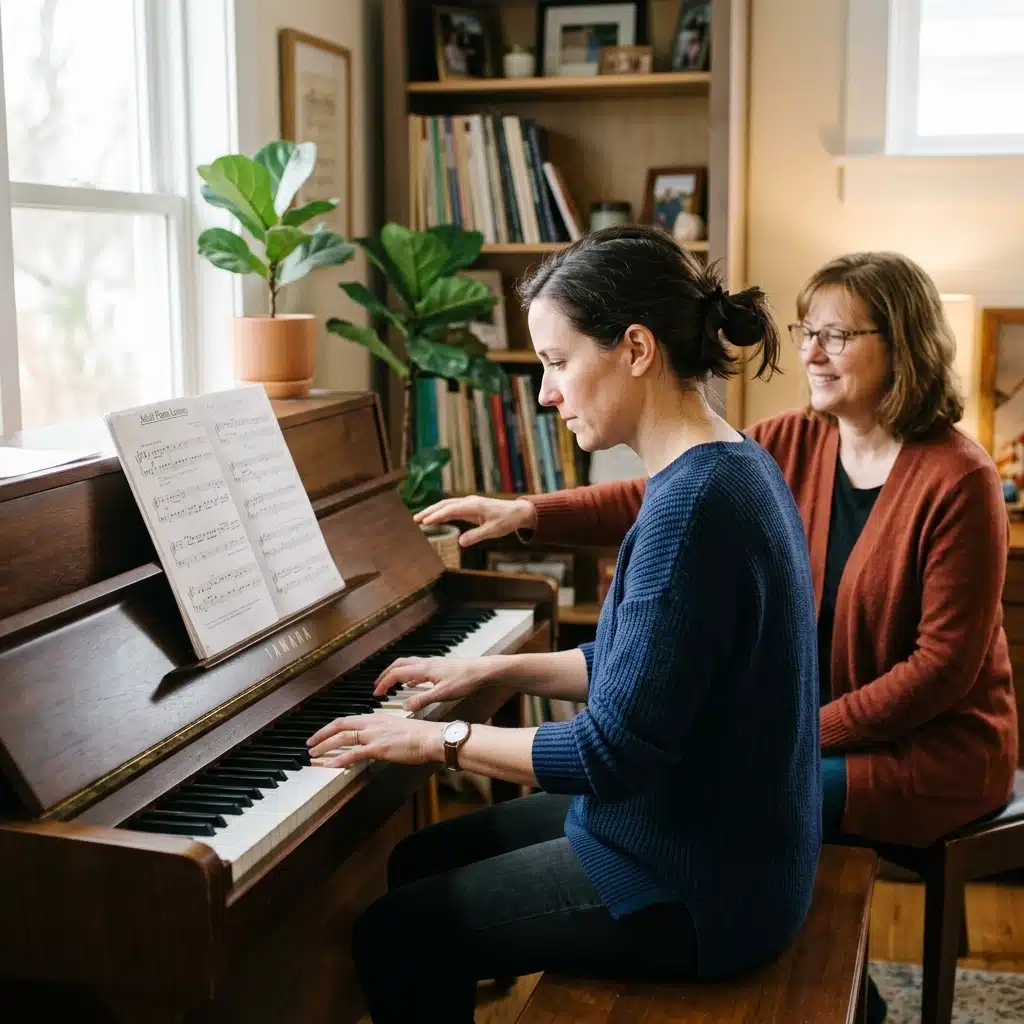
Have you ever sat down at the piano, heart full of ambition and a specific melody in your head, only to walk away thirty minutes later feeling more frustrated than when you started? If so, you are not alone. Many adults come to me at KeyNotes Piano Studio with a similar story: they’ve bought the keyboard, they’ve downloaded the apps, and they’ve watched the tutorials, yet the music remains elusive.
Learning the piano as an adult is a noble pursuit. It isn’t just a hobby; it is a fundamental tool for cognitive development and character building. It engages the cerebral cortex in ways few other activities can, requiring a synthesis of physical coordination, mathematical precision, and emotional expression. However, the path to mastery is often blocked by a series of common pitfalls.
Unlike children, who often follow a teacher’s instructions without overthinking, adults tend to bring their own baggage: expectations, "life experience," and a desire for efficiency: that can actually hinder progress. Let’s examine the seven most common mistakes adult learners make and, more importantly, how we can fix them through the structured environment of adult piano lessons.
1. The "Beethoven’s Fifth" Trap: Choosing Pieces That Are Too Hard
The most frequent mistake I see is the adult learner who wants to play Clair de Lune or a complex Chopin Nocturne within their first month. While I admire the ambition, jumping into advanced repertoire before you have the foundational skills is a recipe for burnout.
When you choose a piece that is significantly above your current skill level, you aren’t actually learning music; you are memorizing a sequence of finger movements through sheer repetition. This lacks intrinsic value because it doesn't build transferable skills. If you struggle through one hard piece for six months, you still won't be able to play a simpler piece at sight.
The Fix: Focus on a "volume" approach. At KeyNotes Piano Studio, we encourage students to work through multiple shorter, level-appropriate pieces. This builds confidence and ensures you are mastering the technical requirements of each grade level before moving on. Think of it like learning a language: you wouldn't try to read Tolstoy before you can comfortably read a newspaper.
2. YouTube University Syndrome: Passive vs. Active Learning
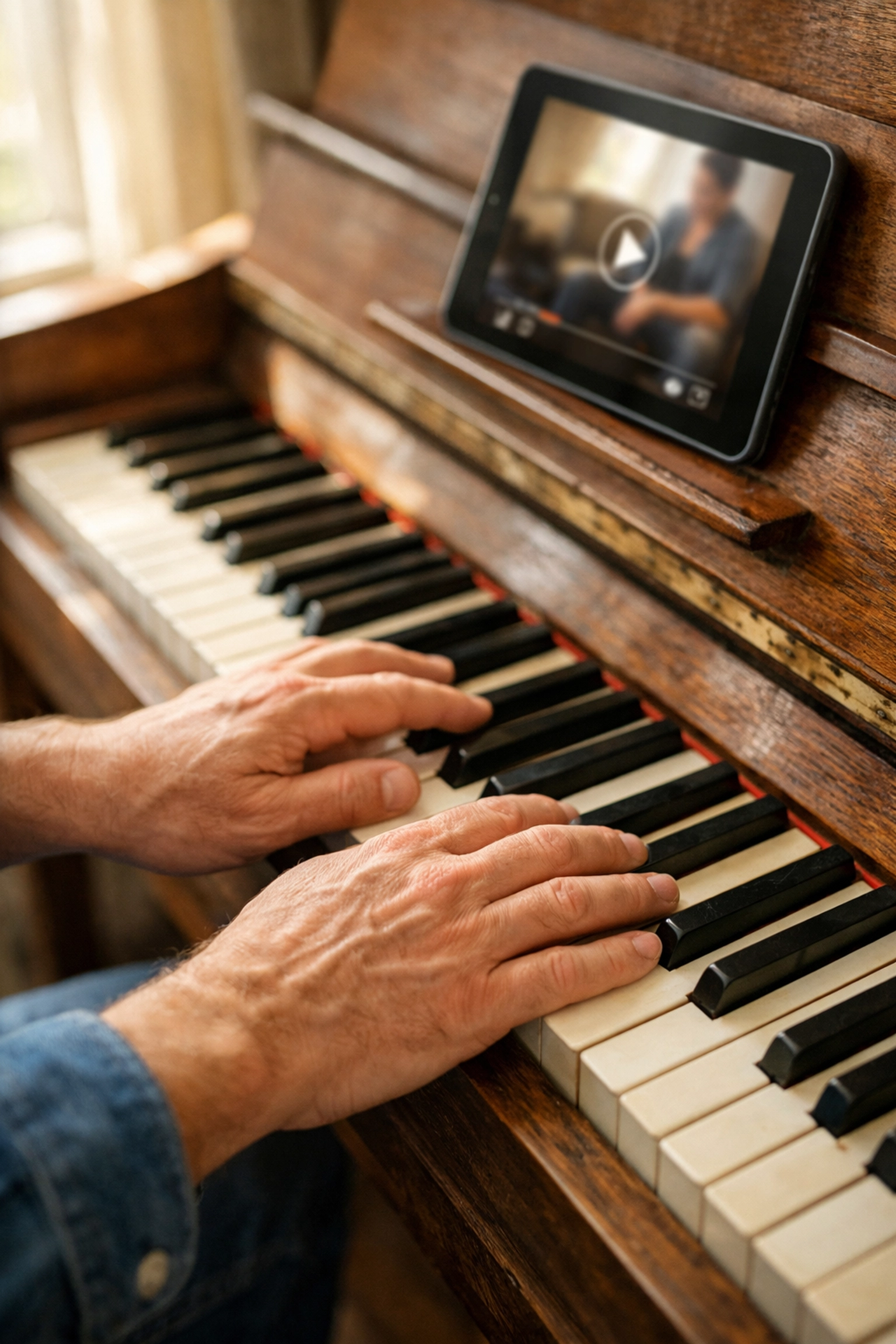
In our digital age, the temptation to rely solely on video tutorials is immense. While YouTube can be a great resource for inspiration, it often leads to what I call "passive learning." You watch a 10-minute video of someone’s hands moving over the keys, and your brain feels like it has learned something. But the moment you sit at the piano, that knowledge evaporates.
This is much like watching a fitness video and expecting your muscles to grow. Music is a physical discipline. It requires sustained effort and tactile feedback.
The Fix: Move from passive consumption to active practice. For every minute you spend watching a tutorial, spend ten minutes with your hands on the keys. Better yet, engage with in-person music lessons in Tallahassee. A professional instructor provides the real-time feedback that a video simply cannot, correcting your hand posture and tension before they become ingrained habits.
3. The Myth of "Inspiration-Based" Practice
Many adults treat piano practice like a creative whim: they play when they "feel like it." Unfortunately, mastery does not bow to your mood. Relying on inspiration is one of the quickest ways to stall your progress.
We often view music as an "art," which it is, but the process of learning it is much closer to Math or History. It requires a structured, logical progression. Just as you wouldn't expect to pass a calculus exam by only studying when the mood strikes, you cannot expect to develop hand-eye coordination and muscle memory without a schedule.
The Fix: Create a defined practice routine. Consistency is more important than duration. Fifteen minutes of focused practice every single day is infinitely more effective than a three-hour marathon once a week. Treat your practice time as an unmovable appointment in your calendar.
4. Ghosting the Fundamentals: Skipping Scales and Theory
I get it: scales aren't "fun" in the traditional sense. Most adults want to skip the "boring stuff" and get straight to the songs. However, neglecting technical exercises and music theory is like trying to build a house on sand.
Rhythm, in particular, is the heartbeat of music. I have seen countless students play the right notes but with such poor timing that the melody is unrecognizable. This is often where DIY methods fall short. Without a teacher to hold you accountable to a metronome, rhythm is usually the first thing to go.
The Fix: Integrate at least one technical exercise: a scale, an arpeggio, or a Hanon exercise: into every practice session. Understanding the "why" behind the music (theory) makes the "how" (playing) much easier. At our studio, we blend theory directly into the pieces you enjoy, so it never feels like a dry academic chore.
5. The Fear of the Mirror: Not Recording Yourself
Adults are often their own harshest critics, yet they rarely use the most objective tool at their disposal: the recording. When you are playing, your brain is occupied with the mechanics of the notes, the fingering, and the foot pedals. You literally do not have the "bandwidth" in your cerebral cortex to accurately hear what you sound like.
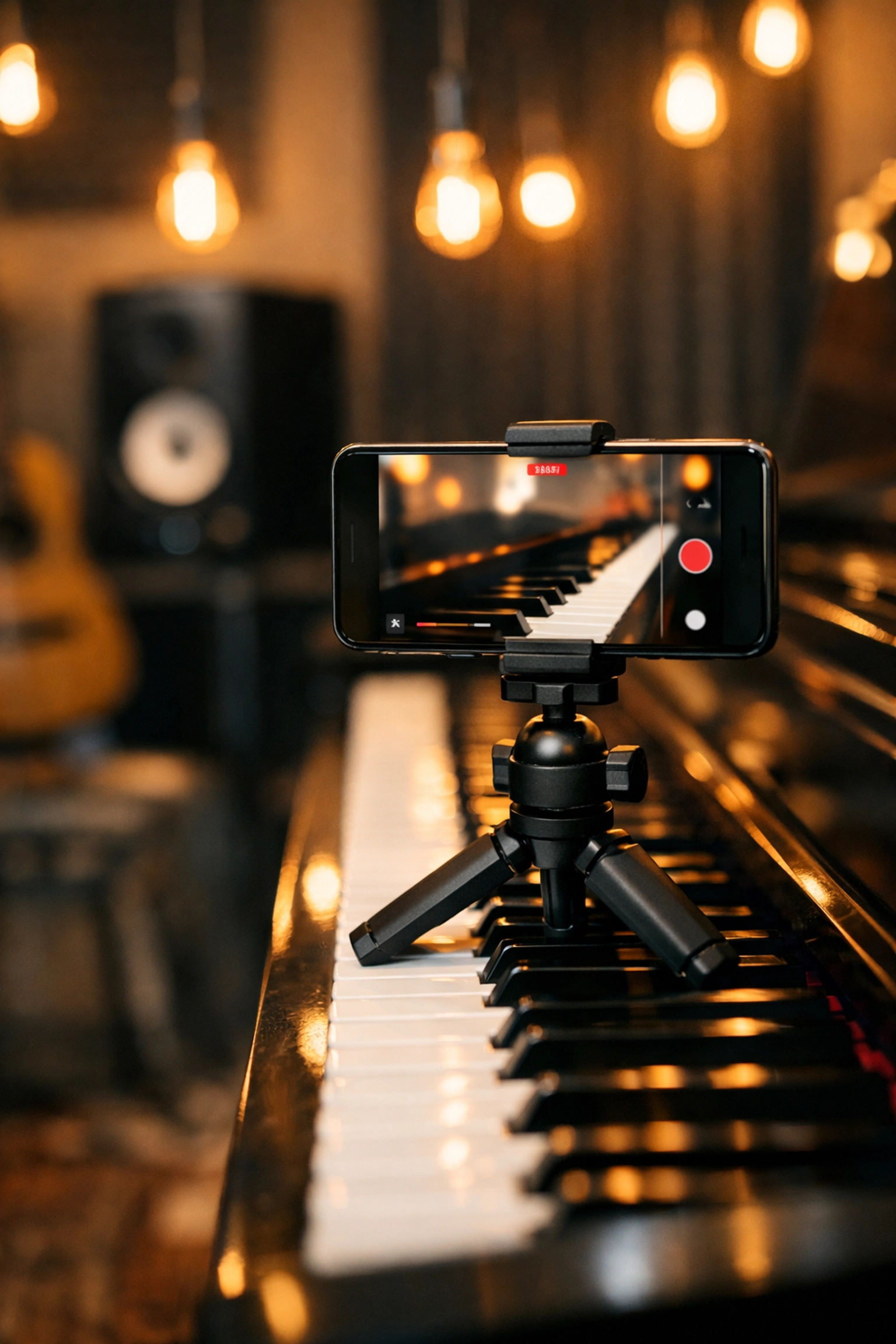
The Fix: Record yourself once a week. It doesn’t have to be high-quality; a simple phone recording will do. When you listen back, you will hear the hesitations, the uneven rhythm, and the missed dynamics that you were deaf to while playing. This objective feedback is crucial for discipline and self-correction.
6. The "Marathon" Approach: Not Chunking Your Music
When faced with a new page of music, the natural instinct is to start at measure one and play until the end. If you make a mistake in measure 12, you stop, go back to measure one, and try again. This is incredibly inefficient. You end up being an expert at the first three measures while the rest of the song remains a mystery.
The Fix: Use "chunking." Break the music into small, manageable segments: sometimes just two measures at a time. Do not move on to the next segment until you can play the current one three times in a row without a mistake. This focused approach allows you to crush practice plateaus and actually learn the entire piece, not just the intro.
7. The "Adult Ego" and Over-Intellectualizing
Perhaps the most significant hurdle for adult learners is the ego. We are used to being competent in our professional lives. Sitting down at a piano and feeling like a beginner can be a blow to our confidence. We try to "think" our way through the music, analyzing every note instead of letting the physical habit take over.
The Fix: Embrace the "Beginner’s Mind." It is okay to play slowly. It is okay to make mistakes. In fact, mistakes are the data points your brain needs to improve. At KeyNotes Piano Studio, we provide a supportive, friendly environment where adults can shed the pressure of perfection and rediscover the joy of learning.
Why Professional Guidance is the Ultimate "Fix"
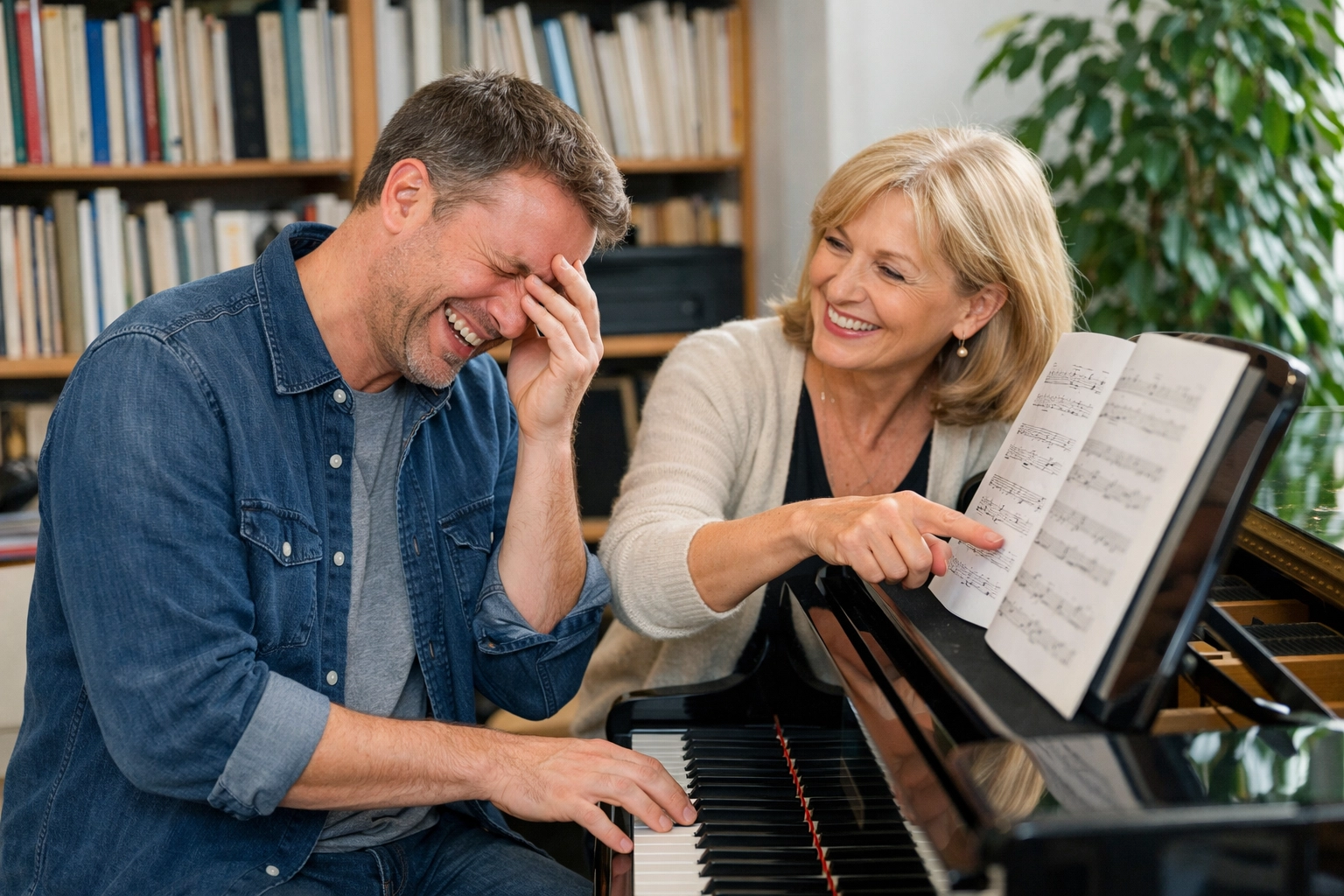
While these mistakes are common, they are also entirely preventable. The common thread among all these "fixes" is structure. This is where professional adult piano lessons make the difference.
Whether you are here in Tallahassee or joining us for online sessions, a teacher acts as a mirror, a coach, and a strategist. We help you choose the right repertoire, design your practice plan, and keep you accountable to the fundamentals that lead to true mastery.
Piano is a lifelong journey. It is a commitment to your own personal growth and cognitive health. Don't let easily fixable mistakes stand in the way of the music you’ve always wanted to play.
Are you ready to stop the frustration and start making real progress? Check out our about the instructor page to see how we can tailor a learning plan specifically for your adult lifestyle. Let’s turn those "mistakes" into milestones together.
