
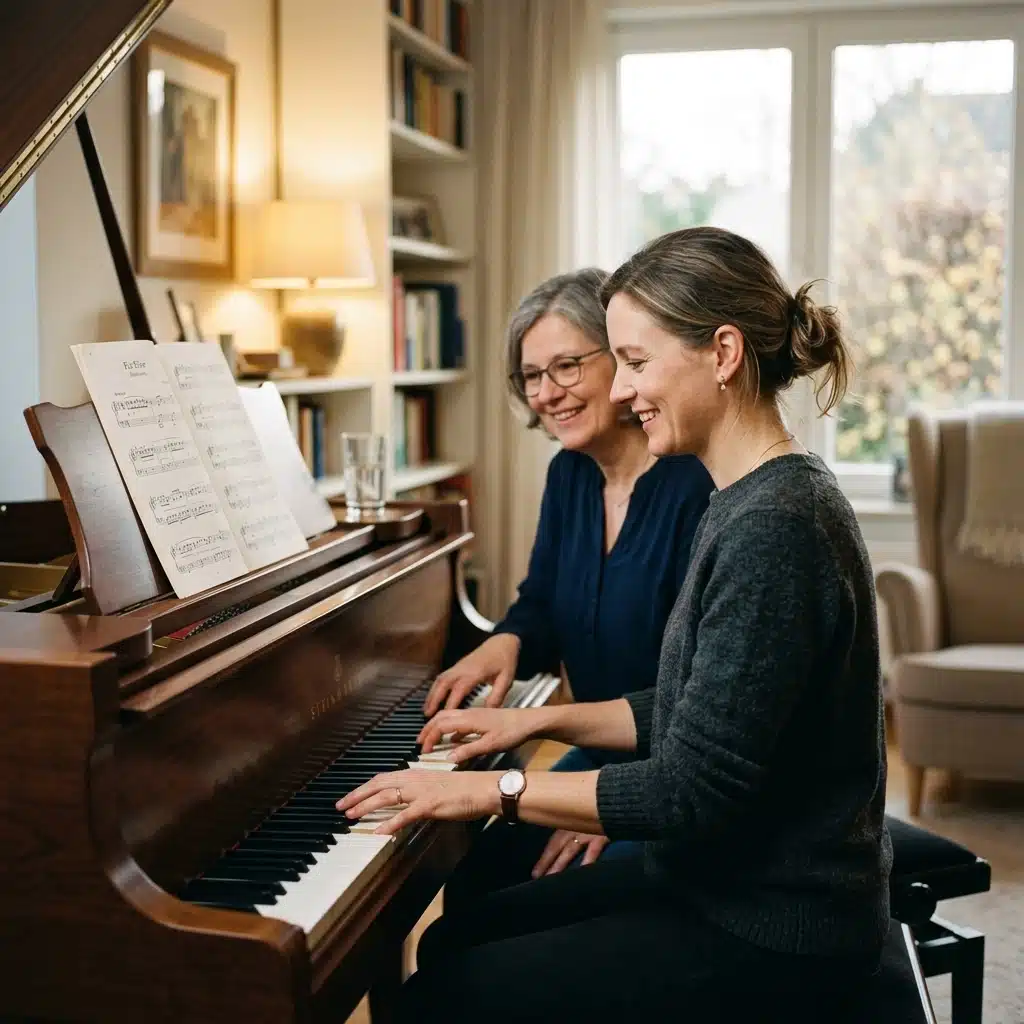
Have you ever sat down at your piano after a long day in Tallahassee, heart full of ambition, only to find yourself playing the same three pages over and over, making the same mistakes in the same spots, and feeling more frustrated than when you started?
It is a common scene for many of our students here at KeyNotes Piano Studio. As adults, we are often our own harshest critics. We approach adult piano lessons with the same drive and efficiency we use in our careers or in managing our households. Yet, music is a unique discipline that doesn't always respond to "brute force" effort. If you feel like your progress has plateaued, or if you’re wondering why that one difficult passage in a Chopin Nocturne remains a stumbling block week after week, I have a secret for you.
The "simple trick" isn't a new app or a special keyboard. It is a fundamental shift in how you process information: The Micro-Chunking Method.
The Power of the Microscope: What is Micro-Chunking?
Most adult learners make the mistake of practicing "horizontally." They start at measure one and play until they hit a mistake, stop, go back to the beginning, and repeat. This is not practice; this is a rehearsal of errors.
The Micro-Chunking Method: a cornerstone of our teaching philosophy: requires you to practice "vertically." Instead of looking at a full page of music, you isolate a section no larger than two to four bars. In some cases, the "chunk" might be as small as a single transition between two chords.
By narrowing your focus to a microscopic level, you allow your cerebral cortex to map the specific motor movements required without the "noise" of the rest of the piece. When you attempt to play a whole page, your brain is busy managing dynamics, rhythm, posture, and upcoming page turns. When you focus on two bars, your brain can dedicate 100% of its processing power to the exact distance between your thumb and pinky.

Why Music is "Audible Mathematics"
We often treat music as a secondary hobby, something "nice" to do if there is time left over after work and chores. However, I challenge you to view your piano lessons in Tallahassee with the same intellectual rigor you would apply to a course in Advanced Calculus or Classical History.
In fact, music is essentially audible mathematics. When you study a score, you are decoding complex ratios, geometric patterns, and logical sequences. Just as you wouldn't try to solve a multi-step algebraic equation by staring at the final answer and hoping it makes sense, you cannot master a piano piece by simply "playing it through."
Micro-chunking is the mathematical equivalent of isolating a variable. By solving for one small "chunk" at a time, the larger "equation" of the musical piece begins to solve itself. This level of sustained effort and logical deconstruction is what builds true discipline and cognitive resilience. It isn't just about playing a song; it's about training your mind to handle complex, multi-layered problems.
The Science of Slowing Down
If micro-chunking is the "what," then "ultra-slow practice" is the "how."
I tell my students that if you can’t play it perfectly, you are simply playing it too fast. To truly improve your performance, you must slow down to a tempo that feels almost agonizing: roughly 50% of the target speed.
Why is this necessary? When you play slowly, you are giving your nervous system the time to receive feedback. You can feel the weight of the key, the tension in your wrist, and the exact moment your finger strikes the ivory. This builds confidence through certainty. If you always practice at performance speed, you are often "skating" over the notes, relying on luck rather than mastery.
At KeyNotes Piano Studio, we emphasize that adult piano lessons are a marathon, not a sprint. Taking the time to build a solid foundation through slow, deliberate practice prevents the "ingrained mistakes" that often cause adults to quit out of frustration later on.

Why In-Person Instruction Trumps the Digital Screen
In the modern era, it is tempting to think a YouTube tutorial or a gamified app can replace a teacher. While these tools have their place, they lack the one thing an adult learner needs most: expert diagnostic feedback.
When you attend lessons for adults in person, I am not just listening to the notes. I am watching the angle of your elbow. I am noticing the slight hesitation in your breath before a difficult jump. I am identifying the "why" behind the mistake.
An app can tell you that you hit a C-sharp instead of a C, but it cannot tell you that you hit the wrong note because your posture is causing unnecessary tension in your shoulder. In-person instruction in Tallahassee provides a level of nuance that digital platforms simply cannot replicate. The human connection, the immediate correction, and the tailored encouragement are what turn a "hobby" into a life-changing skill.
Addressing the "Time" Objection
The most common "pain point" for Tallahassee adults is, invariably, time. "I don’t have an hour a day to practice," is a phrase I hear often.
Here is the professional truth: Ten minutes of deliberate, micro-chunked practice is more valuable than two hours of mindless playing.
If you have ten minutes, don't play the whole song. Pick one "chunk": those two difficult bars: and play them five times perfectly at a slow tempo. Then, walk away. You have done more for your brain’s development in those ten minutes than a student who spent an hour playing the same piece with the same mistakes.
Consistency is the key to improved hand-eye coordination and memory retention. Your brain processes what you’ve learned while you sleep. By giving it small, high-quality "packets" of information daily, you are feeding the learning process in the most efficient way possible.

The "Long-Term" Philosophical Outlook
We often get caught up in the "technical proficiency" of music: how fast we can play or how many pieces we know. But at its core, learning the piano as an adult is about the development of the whole person.
It is an exercise in humility. It is a lesson in patience. In a world of instant gratification, the piano demands that we slow down and earn our progress. There is an intrinsic value in doing something difficult simply because it is beautiful and requires our full attention.
Whether you are looking for a creative outlet or a way to keep your mind sharp as you age, the piano offers a unique blend of physical, emotional, and intellectual stimulation. By applying the simple trick of micro-chunking, you remove the barrier of frustration and open the door to a lifetime of musical enjoyment.
Take the Next Step in Tallahassee
If you’ve been feeling stuck in your musical journey, or if you’ve been waiting for the "right time" to start, consider this your invitation. The Tallahassee community is full of vibrant, busy adults who have found a second home at our studio.
Don't let another year go by wishing you could play. Let’s work together to break those complex pieces down into manageable, beautiful chunks. You can learn more about our benefits of piano study or check our calendar to see how we can fit into your busy schedule.
Improving your piano skills doesn't require a miracle: it just requires a change in perspective. Start small, stay consistent, and remember: the beauty is in the details.

Are you ready to see what your hands are truly capable of? Join us at KeyNotes Piano Studio and let’s start micro-chunking your way to mastery. Whether you are a total beginner or returning to the keys after decades away, the "simple trick" works for everyone. See you at the bench!
