Have you ever caught yourself singing along to your favorite record in an empty kitchen, only to abruptly quiet your voice the moment someone else walks into the room?
That instinctual wave of self-consciousness is something we encounter nearly every single day at our studio. Adults across Tallahassee frequently tell us, "I’d love to take vocal lessons, but I need to get better on my own first so I don't embarrass myself." It is a paradox as old as time: waiting until you are already proficient at something before allowing yourself to be taught how to do it. Just as you would not refuse to enroll in a mathematics seminar because you haven't yet mastered calculus, you do not need to possess a polished, performance-ready voice to step into a professional studio. In fact, formal training is not meant to showcase an already-finished product; it is the deliberate, architectural process of building the voice from the ground up.
When is an adult actually ready to begin voice training? The threshold has nothing to do with innate talent or hitting every high note on day one. It has everything to do with curiosity, emotional readiness, and a willingness to embrace the intrinsic value of disciplined practice.
Here are five undeniable signs that your voice is ready for formal training, and why shedding your hesitation will transform more than just your singing.
1. You Relish the Mechanics of Sound More Than the Illusion of Perfection
When you listen to a vocalist, do you hear a mysterious, untouchable gift, or do you hear air pressure, vocal fold closure, resonance chambers, and physical coordination?

When your intellectual curiosity shifts toward how sound is produced, you have graduated past the amateur mindset. Voice training is fundamentally an anatomical study coupled with artistic expression. The cerebral cortex engages deeply when you begin treating your body as an acoustic instrument. If you find yourself wondering how resonance works in the mask of the face, or why your breath support feels fleeting during a long phrase, your mind is primed for formal instruction.
At KeyNotes Piano Studio, our approach to lessons for adults strips away the intimidation of performance anxiety. We demystify the vocal tract so that mastering pitch, tone, and projection becomes an empirical, satisfying science rather than an elusive guessing game.
2. You Are Tired of Vocal Fatigue and Want Sustainable Technique
Do you find that your throat feels raspy or exhausted after thirty minutes of talking in a loud room or singing in the car?
Many adults assume this fatigue is an immutable physical limitation: a sign that they simply "weren't built to sing." In reality, vocal strain is almost always a mechanical error. Without proper diaphragmatic engagement and laryngeal posture, the delicate vocal folds absorb friction they were never designed to endure.
Pursuing singing lessons in Tallahassee is not merely about hitting notes with aesthetic beauty; it is about physiological preservation. Just as proper form protects a runner’s knees from injury, structured vocal training instills endurance, resilience, and vocal health. When you recognize that your voice deserves ergonomic care and sustainable mechanics, you are demonstrating the exact maturity required for serious study.
3. You Crave the Uncompromising Focus of Live, In-Person Mentorship
In an era dominated by algorithmic shortcuts and digital tutorials, it is tempting to believe that vocal mastery can be downloaded through a screen. Yet, true artistic development demands a dynamic feedback loop that only in-person instruction can provide.

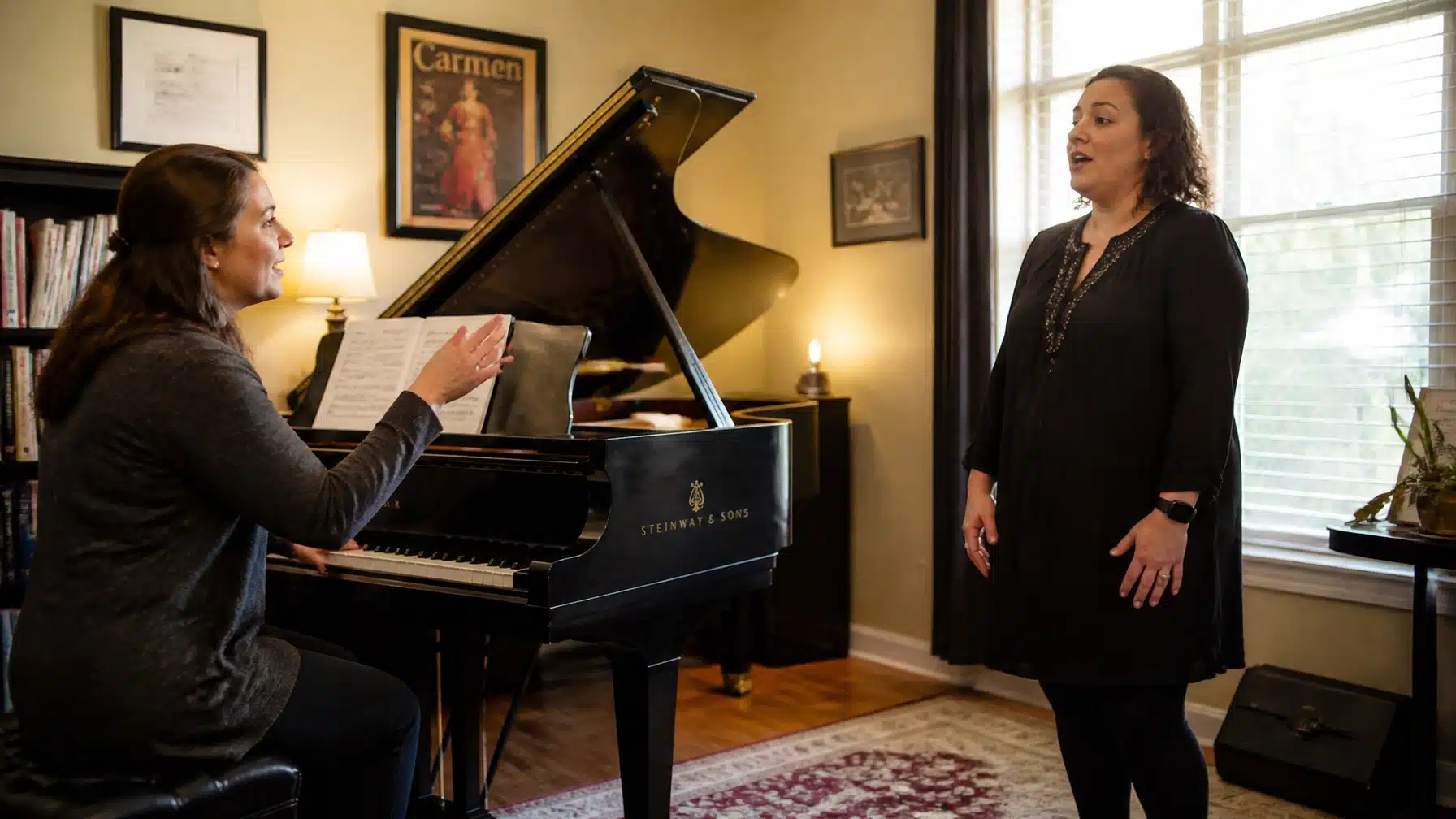
Why do live, face-to-face sessions outperform remote alternatives for beginners? Because acoustics are physical, spatial, and visceral. A seasoned mentor in the room with you can perceive subtle shifts in your jaw tension, posture, and resonance vibrations that pixelated video feeds inevitably miss. In-person instruction fosters deep concentration, accountability, and an authentic human connection that screens cannot replicate.
If you are seeking a distraction-free sanctuary where you can fully immerse yourself in artistic growth without the temptation to check your notifications, your spirit is primed for the tangible discipline of a live studio environment.
4. You Are Willing to Embrace "Beginner’s Mind" and Systematic Effort
Excellence in any rigorous discipline: whether mastering history, chemistry, or musical composition: requires sustained effort over time. Yet modern culture conditions us to expect instant gratification, leading many adults to abandon hobbies the moment they encounter initial awkwardness.
When you commit to regular voice training, you must cultivate what Zen philosophers call shoshin, or "beginner's mind." You must be entirely comfortable sounding imperfect, cracking on a vowel, or untangling deeply ingrained muscular habits. This process builds profound character, self-discipline, and emotional resilience.
The moment you decide that the journey of gradual improvement is more rewarding than the immediate comfort of staying silent, your mindset shifts from passive consumer to active creator. You realize that making mistakes in front of a mentor is not a vulnerability, but the very crucible in which competence is forged.
5. You Want to Ground Your Creative Expression in Structural Literacy
Many aspiring singers harbor a secret fear that studying technique will sterilize their natural emotion, reducing soulful music into mechanical drills. But history teaches us the exact opposite.
Consider the greatest literary writers or classical composers: their boundless creativity was only possible because they mastered grammar, syntax, and counterpoint first. Form does not shackle expression; it liberates it.
When you seek formal training, you are learning the grammar of music: sight-reading principles, interval recognition, phrasing dynamics, and tonal color. This structural literacy gives you the vocabulary to translate the complex emotional landscape of your inner life into precise acoustic reality.
Redefining What It Means to Be "Ready"
Why do we hold ourselves to impossibly high standards of perfection before we even allow ourselves to learn?
The truth is simple: waiting until you are "good" before taking lessons is a logical fallacy. Lessons are the vehicle, not the destination. By committing to live instruction right here in our community, you are investing in your cognitive vitality, your physical health, and your artistic soul.

Whether you are looking to balance a demanding career with a meaningful creative outlet or simply want to discover what your true range sounds like, KeyNotes Piano Studio provides a welcoming, expert-led environment tailored specifically to adult learners. Your voice does not need to be polished before you arrive; it only needs your willingness to begin.
Contact us today to schedule your first in-person session and take the first step toward a stronger, more resonant voice.
