Have you ever sat at the piano bench or stared at a guitar fretboard, wondering if pressing play on a YouTube tutorial or logging into a webcam session is genuinely robbing you of the mastery you seek?
When parents sign their children up for lessons: or when adults decide to finally fulfill a lifelong dream of playing an instrument: the modern marketplace presents an overwhelming crossroads. Do you choose the absolute convenience of a digital screen, or do you commit to the traditional sanctuary of a physical studio? It is a question we hear nearly every day at KeyNotes Piano Studio.
Rather than relying on mere tradition or tech-industry hype, we decided to look at what empirical research, neurological studies, and decades of teaching experience actually reveal. When we crunched the numbers, the results challenged a few popular assumptions while confirming others. Here is the unvarnished truth about online versus in-person music lessons for beginners.
The Cognitive Blueprint: Why Learning an Instrument is Not Like Learning Math
Before evaluating the delivery mechanism, we must first establish the gravity of what we are teaching. Learning to play the piano, guitar, or sing is not a casual hobby comparable to scrolling through an educational app or memorizing historical dates for a Friday quiz. It is a total-brain workout that engages the cerebral cortex, motor pathways, auditory processing centers, and emotional regulation networks simultaneously.
When a beginner practices an instrument, they are undergoing neuroplastic structural changes. They are building improved hand-eye coordination, developing acute auditory discrimination, and forging deep neural pathways that govern sustained effort and discipline.

Just as you would not expect a student to master calculus entirely through pre-recorded video without an instructor correcting algebraic syntax in real-time, musical literacy requires rigorous foundational scaffolding. The debate, therefore, is not whether music education is valuable: its intrinsic value is unquestionable: but whether the medium through which it is transmitted compromises that cognitive transformation.
What the Data Says: Online vs. In-Person Effectiveness
Let us look at what large-scale educational research and music pedagogy studies reveal about learning outcomes:
- Comparable Skill Acquisition on Paper: Multiple comparative studies examining beginner instrumentalists have found no statistically significant difference in final technical skill acquisition between online and face-to-face instruction when practice time and teacher quality are held constant.
- The Retention and Engagement Paradox: Surprisingly, some structured online program datasets show that remote learners exhibit higher initial attendance rates and convenience-driven persistence, primarily because travel friction is eliminated.
- The Hidden Pitfall for Beginners: While digital formats score high on convenience, beginners frequently struggle with foundational physical habits: such as wrist tension, bow holds, or vocal diaphragmatic support: that are exceedingly difficult to diagnose and correct over a compressed video window.
Why do these discrepancies matter? Because a beginner does not merely need information; they need real-time tactile correction. This is why educational specialists consistently point out that while online learning is exceptionally efficient for intermediate theory or review, early-stage motor habit formation thrives in an environment where subtle micro-adjustments can be made instantly.
The Undeniable Power of In-Person Instruction
While digital connectivity has revolutionized how we access information, music is fundamentally a vibrational, acoustic art form. There is an irreplaceable magic that occurs within the walls of a physical studio: whether you are taking piano lessons in Tallahassee or working on vocal projection.

1. Tactile Precision and Posture Correction
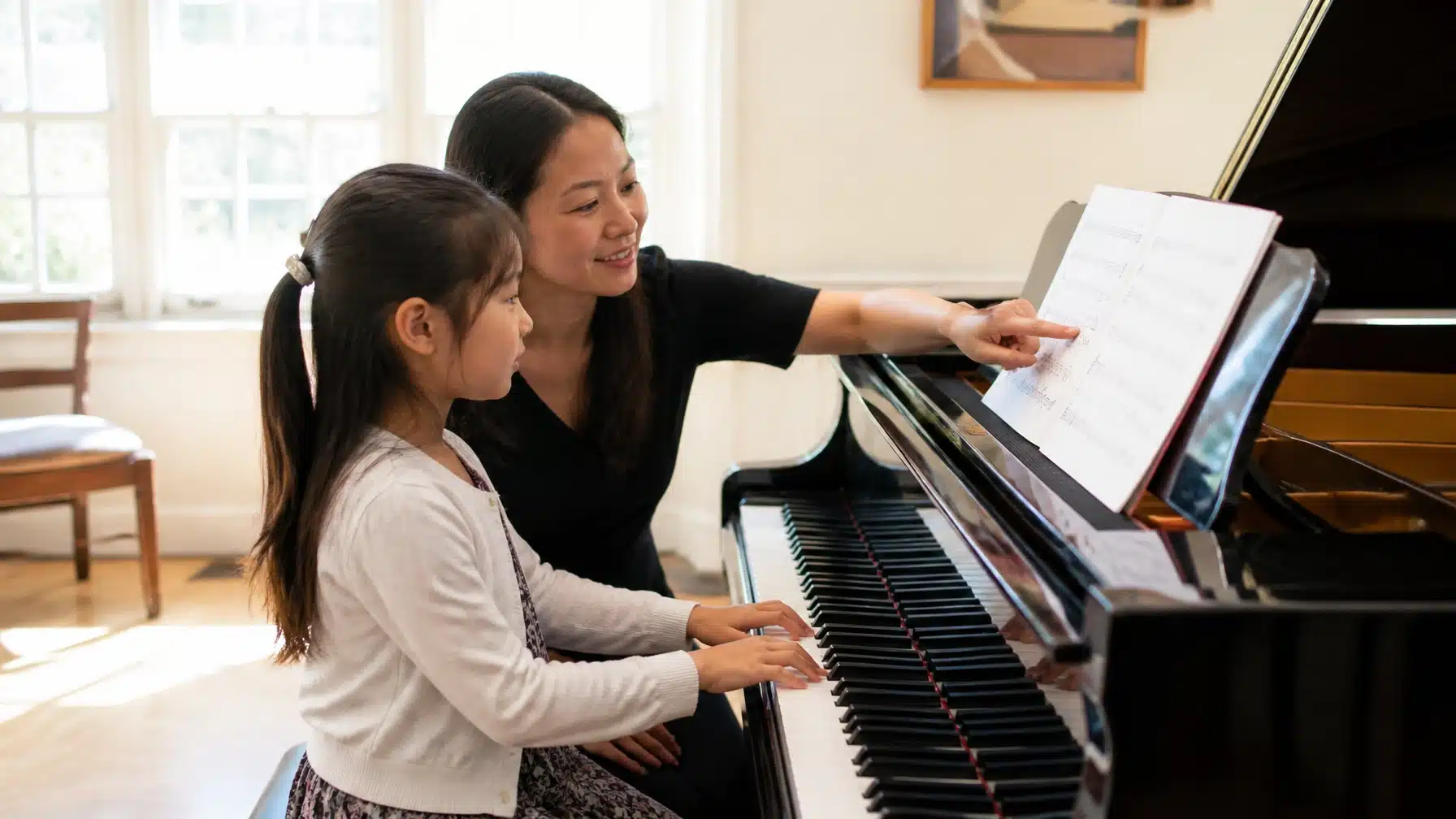
In those critical first three months, bad habits form in seconds and take years to undo. An instructor sitting beside you can gently adjust your wrist angle, demonstrate proper finger curvature on the keys, or help you feel the resonance of a guitar chord in ways that a two-dimensional camera angle simply cannot convey. As we explore in our guide on why solo practice sometimes falls short, having a mentor physically present eliminates guesswork before it hardens into frustration.
2. Acoustic Fidelity and Ear Training
Digital compression algorithms filter out subtle overtones, dynamic nuances, and acoustic subtleties. Developing a refined musical ear requires experiencing true acoustic resonance in a resonant room. When a student hears how a piano truly sings under skilled fingers just inches away, their internal standard for tone production elevates instantly.
3. Deep Focus and Accountability
The modern home environment is a battleground of digital distractions: notifications, household noises, and sibling interruptions. Stepping into a dedicated music studio creates a psychological boundary where the outside world fades away, fostering deep concentration and unshakable confidence.
When Online Lessons Shine: Flexibility Meets Focused Goals
To be fair to the data, online music instruction is far from obsolete. For adult learners with demanding travel schedules, busy families juggling hectic weeknights, or students seeking specialized instruction unavailable in their immediate geographic area, online lessons offer an incredible bridge to artistry.
When paired with proper camera setups and high-quality microphones, online learning provides:
- Unmatched convenience that slashes commute times and keeps consistent lesson momentum alive.
- Access to world-class mentors regardless of zip code.
- The ability to record lessons for later review, allowing students to replay complex explanations during home practice sessions.
For older teens and disciplined adults who already possess foundational posture habits, online lessons can be remarkably productive: a fact we frequently highlight when discussing guitar app alternatives and digital progress.

The Hybrid Future: The Best of Both Worlds
So, which one actually works better for beginners?
When we crunch the numbers and examine the long-term human development of the student, in-person instruction remains the gold standard for laying initial technical foundations, especially for children and absolute beginners tackling complex instruments like the piano or guitar. However, rigid dogmatism serves no one.
The most successful modern music academies reject the false dichotomy of "online versus in-person." Instead, they embrace a flexible, student-centric philosophy. At KeyNotes Piano Studio, we believe in giving families and adult learners the best of both worlds: offering rigorous, immersive in-person lessons right here in Tallahassee alongside robust digital support options for when life requires flexibility.
Are you ready to discover what disciplined, inspired music education can unlock in you or your child? Whether you are looking for structured in-person guidance or flexible digital sessions, investing in professional mentorship is the single greatest step you can take toward musical fluency.
Explore our lesson programs today and take the first step on your musical journey with confidence.
