Have you ever sat down at your piano or picked up your guitar, played a few random notes, and thought, "I wish I knew how to turn this into a real song?"
For many students, there is a glass ceiling between performing music and creating it. We often look at composers like Mozart or Lin-Manuel Miranda as mystical figures who were struck by lightning bolts of inspiration, receiving finished symphonies directly from the heavens. But let me let you in on a secret: music composition is not a divine gift reserved for the "geniuses" of the world. It is a craft. It is a set of tools, a specific vocabulary, and a series of logical steps that anyone: yes, even you: can master with the right guidance.
At KeyNotes Piano Studio, we believe that learning to compose is just as vital as learning to read notes. It is the difference between being able to read a novel and being able to write your own story. Whether you are looking for piano lessons for kids or lessons for adults, integrating composition into your musical journey is the fastest way to achieve true musical literacy.
Debunking the "Genius" Myth
The first hurdle every beginner faces is the psychological barrier that they "aren't creative enough." We treat music composition with a reverence we don't apply to other subjects. In a math class, you aren't expected to be Pythagoras to solve for X; you are taught the formula. In an English class, you aren't expected to be Shakespeare to write an essay; you are taught grammar and structure.
Music is no different. It has its own "grammar" and "logic." When you strip away the romanticized image of the composer struggling over a candle-lit desk, what you find is a builder. Composers are architects of sound. They take small fragments: a rhythm here, a three-note melody there: and they use structural principles to expand them. By understanding these principles, you move from "noodling" on your instrument to creating a cohesive work of art.

Step 1: Capturing the Spark (The "Voice Memo" Phase)
Every great song started as a tiny, perhaps even annoying, little thought. The most common mistake beginners make is waiting for a perfect idea. Perfection is the enemy of composition.
Your first job is simply to capture an idea. This could be:
- A three-word phrase that describes a mood (e.g., "Stormy Tallahassee Afternoon").
- A simple rhythm you tapped on your steering wheel.
- A two-second hum you recorded into your phone while walking the dog.
In our Tallahassee studio, we encourage students to keep a "Musical Journal." Whether you are taking voice lessons or guitar, the ability to record and document your initial impulses is the foundation of discipline and sustained effort. If you don't capture the spark, you can't build the fire.
Step 2: The Motif – The DNA of Your Song
In the world of composition, the "motif" is the smallest recognizable building block of a piece. Think of the opening four notes of Beethoven’s Fifth Symphony (da-da-da-DUM). That is a motif. It’s simple, it’s short, and it’s the DNA for the entire twenty-minute movement.
When you start your composition journey, don’t try to write a five-minute epic. Focus on a 2-to-3 note fragment.
- Identify the symbols: How does this motif look on paper?
- Understand the pitch: Is it moving up, down, or staying the same?
- Repeat and Vary: What happens if you play that motif higher? What if you play it slower?
This process of "thematic development" is where the real magic happens. It engages the cerebral cortex in ways that simple repetition of scales cannot. You are essentially teaching your brain to recognize patterns and create logical extensions of those patterns.
Step 3: Harmony – Providing the Emotional Backbone
If the melody is the "story" of your song, the harmony (the chords) is the "setting." A melody played over a C-Major chord sounds bright and happy; that same melody played over an A-Minor chord suddenly feels haunting and nostalgic.
For our students in Tallahassee, we integrate "Functional Harmony" into every lesson. Understanding how chords like the I, IV, and V relate to one another isn't just dry theory; it’s the key to confidence on your instrument. When you know which chords "fit," you stop guessing and start choosing. This is where the intrinsic value of music education shines: you aren't just mimicking a teacher; you are making informed, artistic decisions.

Step 4: Structuring the Masterpiece (The Blueprint)
Without structure, music is just a "stream of consciousness" that leaves the listener confused. Most beginner compositions benefit from a simple ABA (Ternary) Form:
- Section A: Introduce your main motif and melody.
- Section B: Provide contrast. Change the key, the rhythm, or the register (play higher or lower).
- Section A: Return to the original theme to give the listener a sense of "coming home."
This structural logic is strikingly similar to the way we build arguments in a formal essay or solve multi-step equations in Calculus. By framing music as a fundamental tool for cognitive development, we elevate it from a mere hobby to a core academic pillar.
Integrating Composition into Every Lesson
At KeyNotes Piano Studio, we don't save composition for a "special" class. We bake it into the performance opportunities and daily practice of our students.
- For Piano Students: We use composition to reinforce piano care and technical proficiency. Writing a piece that requires a specific hand position makes the technique "stick" because the student has a personal stake in it.
- For Guitar and Voice: We focus on songwriting. How do lyrics interact with the rhythm of the guitar? This improves hand-eye coordination and vocal control simultaneously.
- For Adults: Many adults come to us through lessons for adults looking for a creative outlet. Composition serves as a powerful form of stress relief and mental clarity, allowing for a level of self-expression that "just playing the notes" can't provide.

Why Composition is a "Core" Subject
We often hear parents ask if music is "extra-curricular." We argue that it is "infra-curricular." While History teaches us where we’ve been and Math teaches us how the world is measured, Music Composition teaches us how to innovate within a system of rules.
A student who can compose a song has developed sustained effort, the ability to handle constructive criticism, and the spatial-temporal reasoning required for high-level engineering or architecture. There is a reason why many of the world’s top scientists and thinkers were also musicians. The "logic of music" is the logic of the universe.
Tools of the Trade: From Pencil to DAW
You don't need a $10,000 home studio to start. In fact, we often recommend starting with the basics:
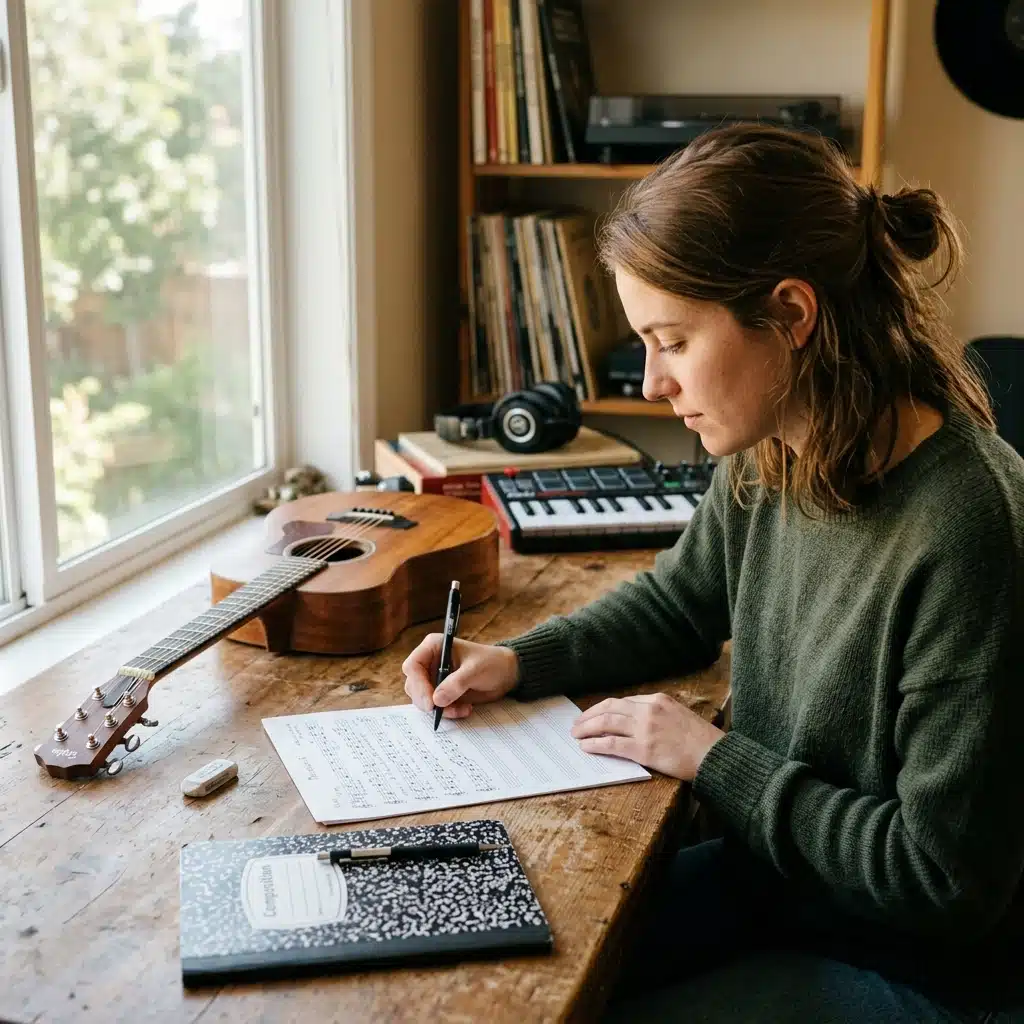
- Pencil and Manuscript Paper: There is a tactile connection between the hand and the brain that is lost when we jump straight to a computer.
- A Digital Audio Workstation (DAW): For older students and adults, programs like GarageBand or Band in a Box can be wonderful for layering sounds.
- Your Voice: If you can sing it, you can write it.
Our instructors are well-versed in the music in Tallahassee scene and can guide you on the best tools for your specific goals, whether you're aiming for the concert hall or the local coffee shop stage.

Start Your Creative Journey Today
If you’ve been feeling stuck in your practice, or if you feel like your musical progress has plateaued, the answer might not be more scales: it might be more creation.
Composition forces you to look at your instrument from the inside out. It builds a level of discipline and intrinsic value that stays with you for a lifetime. Whether you are a beginner or looking to sharpen your skills, we invite you to join us at our Tallahassee studio.
Don't just play the music of the past. Write the music of your future. Check out our about the instructor page to see who will be guiding your creative journey, and let’s start building your first masterpiece together.
Are you ready to find your voice? Contact us today to schedule your first lesson and unlock the composer within.
