Have you ever walked into a room only to forget why you went there in the first place? Or perhaps you’ve noticed a family member, a parent or a spouse, struggling to recall a name that was on the tip of their tongue just moments ago? It is a common, often unsettling experience that many of us attribute to the "inevitable" decline of age. But what if I told you that the key to preserving your most precious memories wasn't found in a pill bottle, but in the 88 keys of a piano?
As a long-time music educator here in Tallahassee, I have sat beside students of all ages. I have seen seven-year-olds master their first scale and seventy-year-olds rediscover a passion they put aside decades ago. But recently, the conversation around adult piano lessons has shifted from mere "hobbyist enjoyment" to a fundamental necessity for cognitive health. The question is no longer just "Can I learn to play?" but rather, "Can learning to play save my mind?"
The latest scientific evidence suggests a resounding yes.
The Kyoto Breakthrough: A Shield for the Aging Brain
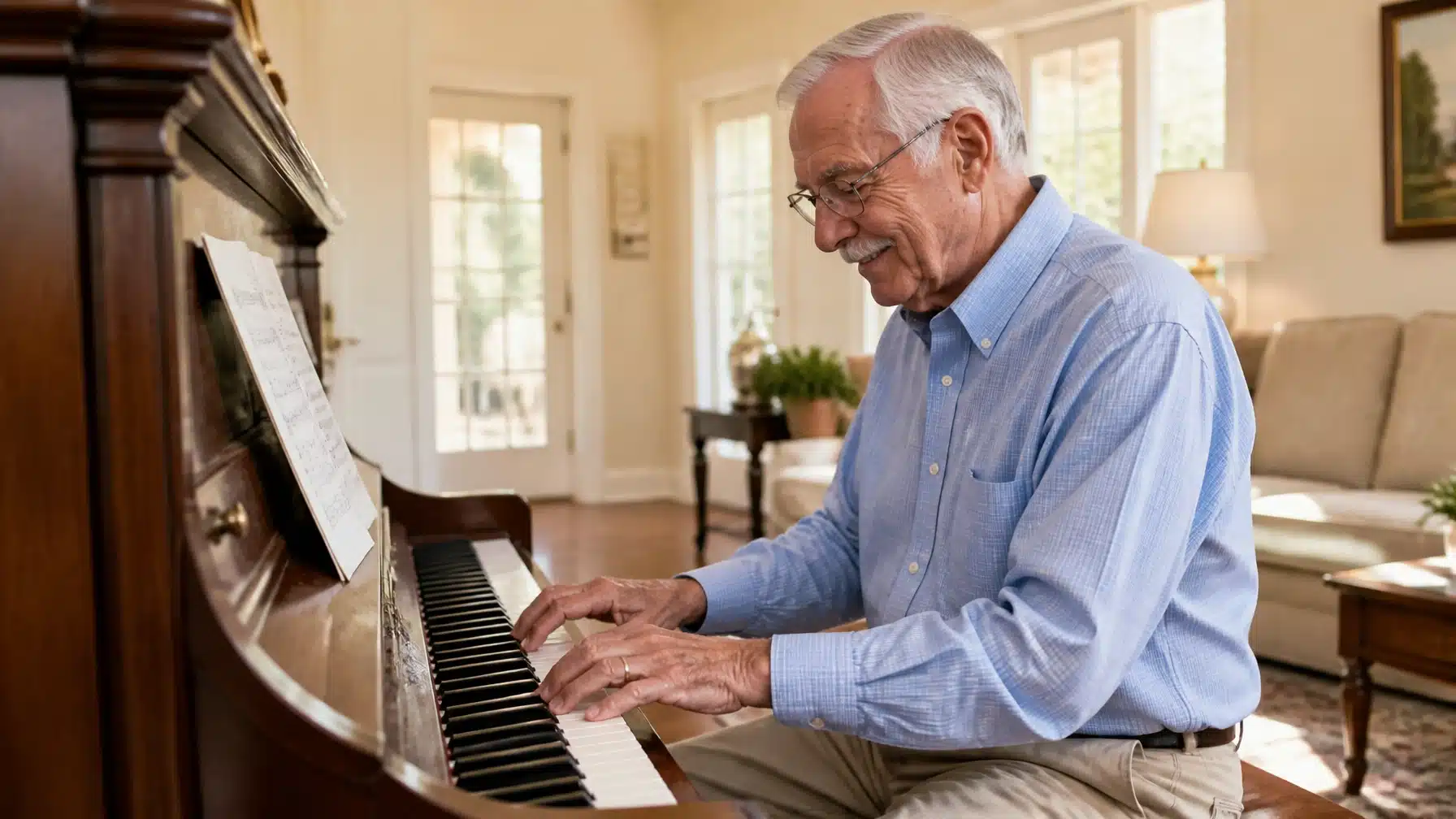
In June 2026, a landmark longitudinal study from Kyoto University sent ripples through the scientific and musical communities alike. Researchers followed a group of older adults, all in their 70s, who were complete beginners to musical instruments. The study wasn't merely looking at whether they could play a recognizable tune; it was peering deep into the architecture of their brains using advanced imaging technology.
The findings were staggering. Participants who engaged in consistent musical training showed a remarkable preservation of gray matter volume in the right putamen: a subcortical region of the brain critical for learning, habit formation, and motor control.
More importantly for those concerned about memory, the study found that these seniors maintained their verbal working memory. While their peers who did not play an instrument saw a typical age-related decline in "digit span" and "verbal fluency" tasks, the piano-playing group effectively "froze" their cognitive clock. In essence, the act of learning an instrument served as a structural and functional shield against the erosion of time.

Beyond "Just a Hobby": The Cognitive Rigor of Music
We often view music as an "extra-curricular" activity, something soft or secondary to "hard" subjects like Mathematics or History. This is a profound category error. In reality, the piano is a high-intensity cognitive workout that rivals any academic pursuit in its complexity.
Consider what happens when you sit down for piano lessons in Tallahassee at our studio. You are not just "playing music." You are:
- Decoding a complex symbolic language (Music Theory/Notation) in real-time.
- Translating those symbols into precise physical movements across two different hands performing independent tasks.
- Engaging in constant error-correction through auditory feedback.
- Managing "sustained effort" and focus for extended periods.
This process engages the cerebral cortex and the cerebellum simultaneously. If Mathematics is the study of logic through numbers, piano is the study of logic through time, tactile sensation, and emotion. It is a fundamental tool for character building and cognitive maintenance that should be viewed with the same intellectual respect as any university-level course.
The "Sustained Effort" Factor: Why You Must Keep Playing
One of the most telling aspects of the Kyoto University study was the difference between the "continue" group and the "quit" group. Those who started lessons but stopped after a few months did not retain the same protective benefits. The brain, much like a muscle, requires sustained effort to maintain its growth.
This is why we emphasize long-term growth at KeyNotes Piano Studio. It isn't about reaching a "finish line"; it’s about integrating music into your lifestyle. Whether you are looking for adult piano lessons or exploring music composition lessons, the goal is the same: consistent, guided engagement that keeps the neural pathways firing.
For the adult children of seniors in Tallahassee, this is perhaps the most important gift you can encourage. It is an investment in your parent’s autonomy and cognitive longevity.
Why In-Person Mentorship Beats the "App" Approach
In an age where everything is available via a smartphone, it is tempting to think that online music lessons or self-taught apps are sufficient. While technology has its place, the science of aging suggests that the social and mentorship aspects of learning are just as vital as the notes themselves.
Learning from a professional instructor provides a level of intrinsic value and accountability that an algorithm cannot replicate. An instructor notices the tension in your shoulders, the slight hesitation in your rhythm, and provides the personal empathy needed to push through the "stuck" moments. This human connection is a powerful stimulant for the brain, reducing the isolation that often accompanies aging and further boosting mental health.
As we've discussed before, in-person lessons help you crush practice plateaus in ways that solitary study simply cannot.

Addressing the "Too Old" Objection
I often hear seniors say, "My hands are too stiff," or "I'm just not as sharp as I used to be." I want to address these "pain points" directly: You are not too old; you are simply out of practice.
The brain’s neuroplasticity: its ability to reorganize itself by forming new neural connections: does not disappear at 65 or 75. It merely requires a different approach. We tailor our lessons to the physical needs of our older students, focusing on ergonomics and gentle repetition to improve hand-eye coordination and flexibility.
The "stiffness" you feel is often more about a lack of movement than a permanent physical limitation. By engaging with the keys, you are literally teaching your nervous system to remain agile.
A Philosophical Shift: The Whole Person
At KeyNotes Piano Studio, we don't just teach you how to play a Chopin nocturne or a jazz standard. We are committed to the development of the whole person. Learning piano at 70 is a declaration that you are still growing, still capable of mastery, and still invested in your own cognitive future.
Imagine your retirement years not as a period of gradual "unplugging," but as a time of vibrant, cerebral expansion. Imagine the pride of your grandchildren as they watch you perform a piece you’ve worked on for months. This is the confidence and discipline that music instills, regardless of when you start.

Take the First Step Today
The science is clear: the right putamen doesn't have to shrink, and your working memory doesn't have to fade. But the window to act is always now. Whether you are a senior resident in Tallahassee or an adult child looking for a life-changing gift for a parent, we invite you to experience the transformative power of the piano.
We offer professional, empathetic, and science-backed instruction right here in the heart of Florida’s capital. Let’s protect your memory together, one note at a time.
Are you ready to see what your brain is truly capable of?
Contact KeyNotes Piano Studio today to schedule your first session and start your journey toward a sharper, more musical future.
