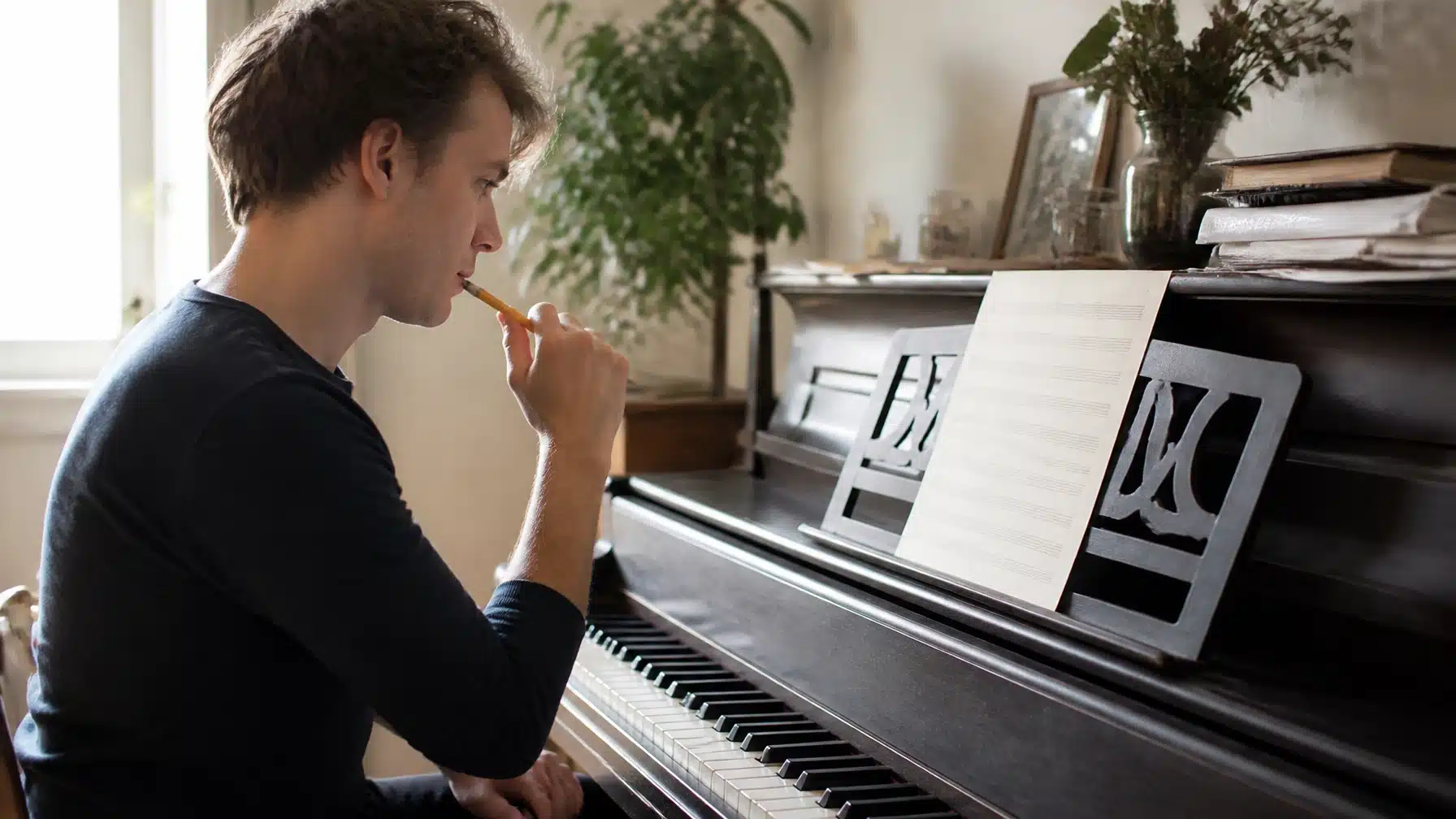
Have you ever sat down at a piano, fingers poised over the keys, only to find your mind as blank as the manuscript paper in front of you? It is a common frustration, often termed "creative block," but in my years as an educator, I have come to view it differently. It is not a lack of inspiration; it is a lack of systematic framework.
As a mentor, I often encounter students who view music composition as a mystical, unreachable talent: something one is either born with or forever lacks. This is a fallacy. In reality, music composition is a discipline as rigorous as Mathematics and as historically significant as World History. To master it, one must move beyond the wait for "the muse" and instead engage in the sustained effort of technical mastery and cognitive expansion.
Whether you are seeking music in Tallahassee or engaging in our online modules, the path to rapid improvement in music composition lessons lies in shifting your perspective from "waiting for ideas" to "building a creative engine."
The Intellectual Rigor of Creation: Music as Math
Why do we often view Math as a "core" subject while music is relegated to a "hobby"? This distinction is purely social, not biological. When you compose, you are not merely "making sounds"; you are engaging the cerebral cortex in complex problem-solving. You are calculating intervals, managing the vertical architecture of harmony, and organizing the temporal structure of rhythm.
In many ways, a fugue by Bach is closer to a complex calculus equation than it is to a simple emotional outpouring. Both require an understanding of patterns, symmetry, and logic. By recognizing the intrinsic value of composition as a cognitive exercise, you elevate your practice.
Music composition lessons should not be seen as a peripheral activity. Just as studying History provides a blueprint for human behavior, studying composition provides a blueprint for human expression. When you learn to manipulate a motif: stretching it, inverting it, or modulating its key: you are training your brain in high-level abstraction and logical deduction.

The Daily Discipline of the ‘Micro-Composition’
The single most common error beginners make is attempting to write a "masterpiece" on their first try. This is equivalent to a first-year math student attempting to solve the Riemann Hypothesis. It leads to paralysis.
The fastest way to improve is through the discipline of small-scale, daily output. I advise my students to commit to the "One-Minute Piece" challenge. For ten consecutive days, your goal is to compose sixty seconds of music. It does not need to be profound. In fact, it can be quite mundane. The goal is not quality; it is fluency.
By forcing yourself to finish a short work daily, you bypass the "perfectionist filter" of the brain. This creates a feedback loop where you are constantly making decisions: deciding on a cadence, choosing a rhythm, or resolving a dissonance. This high-frequency decision-making is where the most significant growth occurs. Over time, you will find that your confidence grows alongside your technical ability, as you realize that you possess the agency to create at will.
Active Analysis: Seeing the Blueprint
If you wish to write great music, you must first learn to see it. Most people listen to music passively, allowing the waves of sound to wash over them emotionally. A student of composition must listen aggressively.
In our music composition lessons, we emphasize "Active Analysis." This involves taking a simple score: perhaps a Chopin Prelude or a Beatles song: and identifying its structural components.
- Where does the melody move by step versus by leap?
- How does the composer use the I, IV, and V chords to create a sense of home and tension?
- What is the specific rhythm that makes the piece feel "urgent" or "restful"?
This practice directly correlates to improved pattern recognition and auditory memory. When you can "see" the blueprint of a great piece, you can begin to use those same architectural tools in your own work. This is not "copying"; it is learning the grammar of the language so that you may eventually write your own poetry.

The Role of a Mentor: Tallahassee & Beyond
While self-study is commendable, there is no substitute for the guided eye of a seasoned expert. In Tallahassee, we offer in-person guidance at KeyNotes Piano Studio, where we can sit side-by-side at the piano. This proximity allows for immediate feedback on the tactile aspects of composition: how a chord feels under the hand or how a melody breathes.
For those outside of North Florida, our online lessons provide the same rigorous curriculum. Whether in-person or remote, the role of the mentor is to provide the discipline that a student might lack on their own. We address the "pain points" of composition: such as voice leading or rhythmic displacement: with practical solutions.
Many adult students hesitate to start, fearing they have "missed the window" for musical development. However, our lessons for adults prove that the adult brain is uniquely suited for the structural complexities of composition. Your life experience provides a depth of "emotional data" that, when combined with technical theory, creates powerful art. You can learn more about the benefits of piano study and how it sharpens the mind at any age.
Overcoming the Beginner's ‘Analysis Paralysis’
Is it better to learn theory first or to just "start writing"? This is a question that plagues many beginners. My uncompromising stance is that you must do both simultaneously.
Theory without application is dry and often forgotten; composition without theory is limited and repetitive. In our sessions, we introduce "Micro-Theory." We learn one concept: perhaps the "Perfect Authentic Cadence": and then we immediately write five different melodies that end with that cadence.
This method ensures that every piece of information you learn has an immediate intrinsic value. You are not just learning a rule; you are gaining a tool. This approach shifts the focus from "Am I doing this right?" to "How can I use this to express my idea?"

The Long-Term Philosophical Outlook
In our modern era of "instant gratification" and AI-generated content, the act of manual music composition is a radical choice. It is an investment in your own cognitive development and character. When you struggle with a difficult transition in a piece for three hours and finally resolve it, you have gained more than just a few bars of music. You have practiced sustained effort, problem-solving, and emotional resilience.
At KeyNotes Piano Studio, we are not just teaching you how to put notes on a page. We are helping you develop the "whole person." Our instructor is dedicated to guiding you through this journey, whether you are a child just starting out or a senior looking for a new mental challenge.
Music composition is the ultimate synthesis of logic and emotion. It is the Math of the soul. By committing to a structured path, embracing the discipline of daily work, and seeking the guidance of a mentor, you will find that the "fastest way" to get better is simply to begin, and then never stop.
Are you ready to stop being a passive listener and start being an active creator? Whether you join us in Tallahassee or via our online platform, the world of music is waiting for your unique voice.
