Is your family still filling in the after-school calendar for fall? Between homework, sports, clubs, and family responsibilities, choosing one more activity can feel overwhelming. Yet the right activity can do far more than occupy an hour each week. It can shape how your child thinks, practices, handles frustration, and develops confidence.
That is why choosing piano lessons for kids deserves more consideration than simply selecting the closest available teacher. A qualified, encouraging instructor can help your child build musical skills while also developing discipline, focus, improved hand-eye coordination, and the confidence that comes from mastering something difficult.
For Tallahassee families searching for piano lessons Tallahassee students can enjoy and sustain, the best choice is usually a local teacher who provides consistent, live instruction and understands how children learn.
Why the Right Teacher Matters More Than the Method Book
Parents often begin their search by asking which method book a teacher uses. That question is reasonable, but it should not be the first or only consideration.
A method book provides material. A teacher provides interpretation, feedback, encouragement, and direction.
Two children can work from the same book and have completely different experiences. One may receive patient explanations, creative activities, and achievable goals. Another may feel rushed, criticized, or disconnected from the material. The difference is not the book. It is the teacher’s ability to adapt.
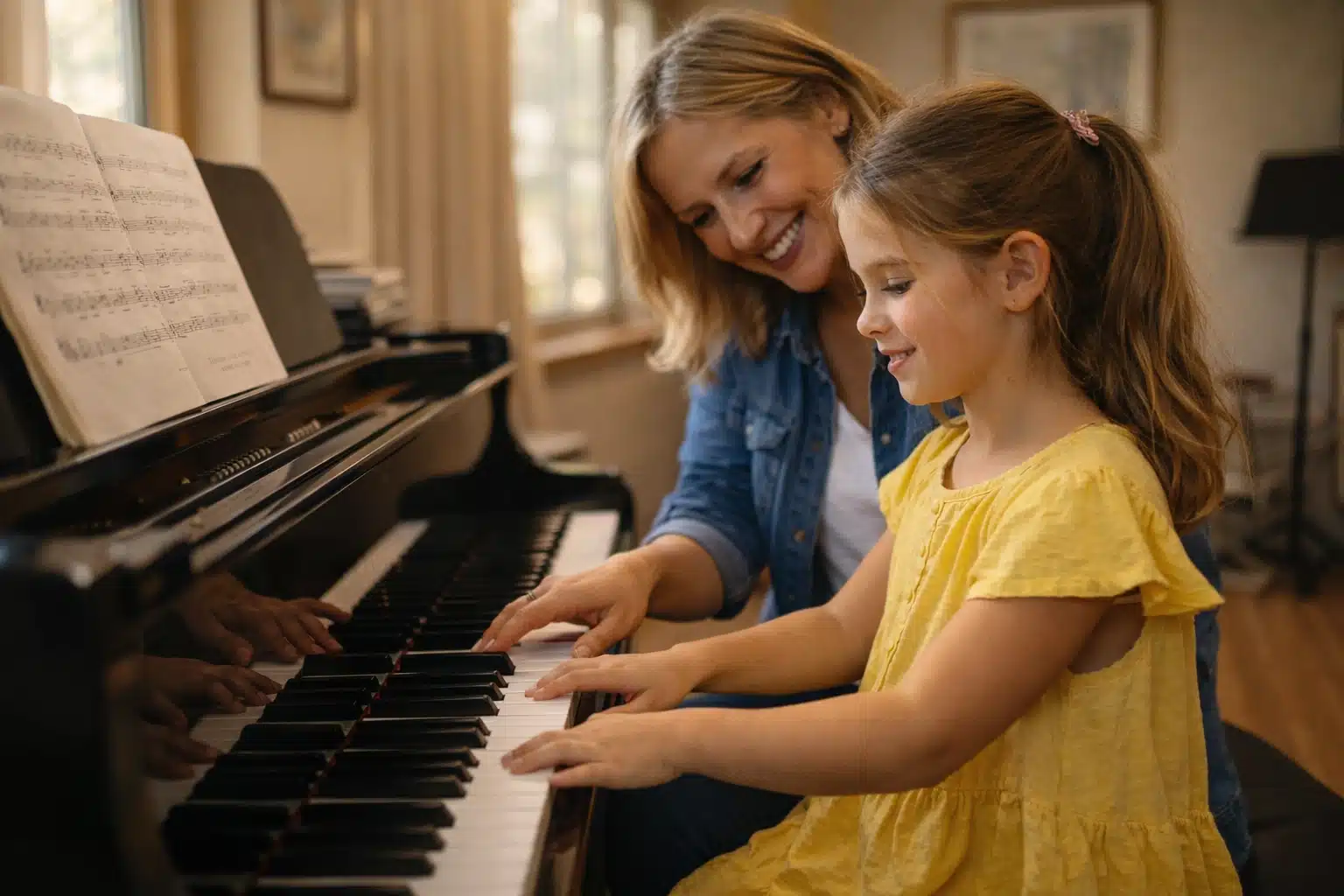
Live instruction is especially valuable for beginners because children are still developing the physical and mental habits required to play well. An in-person teacher can observe posture, hand position, wrist tension, rhythm, attention, and emotional response in real time. A screen can identify a wrong note. A teacher can determine whether the problem comes from confusion, poor fingering, tension, fatigue, or a lack of confidence.
That human judgment creates the foundation for long-term progress.
1. Verify Musical Training and Teaching Experience
A strong piano teacher should be able to explain both what they know about music and how they teach it.
When reviewing a teacher’s background, look for:
- Formal musical training or substantial performance experience
- Specific education in piano pedagogy or child instruction
- Experience teaching beginners, not only advanced performers
- Familiarity with the age and developmental stage of your child
- A clear teaching philosophy
- Professional references, reviews, or studio information
A talented performer is not automatically an effective teacher. Performing and teaching require different skills. A child needs an instructor who can break a complicated idea into manageable steps and communicate it in language the child understands.
Ask direct questions:
- How long have you taught children?
- What ages do you teach most often?
- How do you introduce reading, rhythm, and technique?
- How do you respond when a student becomes frustrated?
- How do you adapt lessons for shy, energetic, or highly independent children?
KeyNotes Piano Studio provides additional information about choosing a piano instructor and its teaching philosophy. These pages can help parents understand the kind of preparation and perspective they should expect from a professional local studio.
2. Look for a Teaching Style That Balances Structure and Enjoyment
Children need structure, but they also need a reason to care.
A teacher should establish clear expectations for practice and progress without making every lesson feel like a test. Effective piano lessons for kids usually combine:
- Technique and posture
- Note reading and rhythm
- Ear training
- Music theory
- Repertoire the child finds meaningful
- Creativity, improvisation, or composition
- Short-term goals that lead toward larger achievements
The balance matters. If lessons focus only on entertainment, the child may enjoy the activity without developing a reliable foundation. If lessons focus only on correction, the child may begin to associate the piano with anxiety.
The best teacher creates productive challenge. Your child should sometimes work hard, but they should also leave lessons knowing what they accomplished and what they can try next.
Music education is not merely an alternative to academic learning. Piano demands abstract reasoning much like mathematics, while interpretation and cultural context engage skills associated with history and literature. Reading music requires decoding symbols, recognizing patterns, managing sequences, and coordinating physical responses. That is a complex form of learning: not a lesser version of “real” schoolwork.
Research supports this broader view. A recent meta-analysis of children’s musical training found meaningful improvements in executive functions, including inhibitory control, working memory, and cognitive flexibility. These are the skills behind self-control, planning, and sustained effort. You can review the findings in this meta-analysis of music training and executive function.
3. Pay Attention to Personality Fit
Your child does not need a teacher who looks or sounds exactly like them. However, your child does need an instructor who can connect with their personality.
Consider your child’s natural temperament:
- Does your child respond well to firm direction?
- Do they need frequent encouragement?
- Are they cautious about making mistakes?
- Do they enjoy choosing their own songs?
- Do they concentrate better when lessons include movement or games?
- Are they motivated by performances and visible goals?
A quiet child may need a warm teacher who creates emotional safety before expecting public performance. An energetic child may need a teacher who uses variety and clear transitions. A highly motivated child may appreciate more advanced challenges.
The teacher should also respect the child as a developing person. Correction should be specific and constructive. “That was wrong” is not instruction. “Let’s slow down and find where the rhythm changed” gives the child a strategy.
The goal is not to eliminate every mistake. The goal is to teach your child how to respond intelligently to mistakes.
4. Compare Studio Lessons and In-Home Lessons
Tallahassee families often have two practical live-lesson options: studio instruction or in-home instruction.
Studio piano lessons
A dedicated studio can provide:
- A professional, well-maintained instrument
- A focused learning environment
- Fewer household distractions
- Opportunities to hear other students
- Recitals, workshops, and community events
- A clear psychological separation between home and lesson time
At a studio, children experience music as a serious and shared activity. They may see older students preparing for performances and begin to imagine their own future progress.
KeyNotes Piano Studio’s studio lessons are designed for families who value that focused environment.
In-home piano lessons
In-home lessons may be preferable when:
- Transportation is difficult
- Several children have activities on the same evening
- A parent wants to remain close by
- The child feels more comfortable learning at home
- The family prefers the convenience of a teacher traveling to them
There is also a practical benefit: the teacher sees the instrument your child will actually use for practice. KeyNotes describes its in-home lesson option for families who want live instruction without adding another commute.
Neither format is automatically superior. The right question is: Which environment will allow your child to attend consistently, focus comfortably, and practice more successfully?
Online lessons can be useful when travel or illness makes an in-person lesson impractical. However, for a young beginner, live local instruction should generally be the starting point whenever possible.
5. Ask About Trial Lessons
Before committing to a full semester, ask whether the teacher offers a trial lesson, consultation, or introductory meeting.
A trial is not simply an audition for your child. It is an opportunity for the entire family to evaluate the relationship.
During the lesson, observe:
- Does the teacher speak directly and respectfully to your child?
- Does the teacher listen before giving instructions?
- Are explanations clear?
- Does the teacher adjust when your child seems confused?
- Does your child have an opportunity to make music immediately?
- Does the lesson include both enjoyment and purposeful instruction?
Afterward, ask your child open-ended questions:
- What did you enjoy?
- What felt difficult?
- Did you feel comfortable asking questions?
- Is there something you would like to learn next?
Do not rely only on whether your child says the lesson was “fun.” Look for curiosity, comfort, and a willingness to return. A child may feel challenged and still be excited. That is often a healthy sign.
6. Clarify Communication and Practice Expectations
A good teacher should make the parent’s role clear.
Ask how the teacher will communicate:
- What the child should practice
- How long practice should last
- Which skills need the most attention
- Whether practice assignments are written or digital
- How progress will be reported
- How missed lessons and make-ups are handled
- Whether parents may observe occasionally
Young beginners often need an adult to help establish a practice routine. That does not mean the parent must become the piano teacher. The parent’s role is to provide time, encouragement, and a suitable instrument. The teacher’s role is to provide instruction and accountability.
For most beginners, short and consistent practice is more effective than an occasional marathon session. A teacher should provide realistic expectations that fit your child’s age and your family’s schedule.
If you are unsure how to support practice at home, explore KeyNotes’ practice help resources.
7. Choose Consistency Over Convenience Alone
September is an ideal time to begin because families are establishing fall routines. Leon County Schools began the 2026–2027 school year on August 12, and the district calendar includes September holidays on Labor Day and September 21. Checking the official Leon County Schools calendar can help you choose a lesson time that will remain workable after the excitement of back-to-school settles.
The most impressive teacher is not necessarily the best fit if the schedule creates constant stress. A sustainable weekly appointment is more valuable than an ideal lesson that your family frequently misses.
Choose a time that leaves room for:
- Transportation
- A snack or short rest after school
- Homework
- Practice
- Dinner and bedtime
- Other important family commitments
Progress depends on continuity. Your child needs repeated contact with the instrument and teacher to build musical memory, physical coordination, and confidence.
A Practical Tallahassee Parent Checklist
Before enrolling, confirm that the teacher or studio:
- Has relevant musical and teaching experience
- Regularly teaches children in your child’s age group
- Uses a supportive but structured approach
- Offers live, in-person instruction in a convenient format
- Explains practice expectations clearly
- Communicates consistently with parents
- Provides a suitable studio or safe in-home environment
- Offers a trial, consultation, or introductory conversation
- Has clear tuition, cancellation, and scheduling policies
- Provides performance or enrichment opportunities when appropriate
The Right Teacher Builds More Than a Pianist
Choosing piano lessons Tallahassee families can trust is not simply a matter of comparing prices or finding the nearest available opening. You are choosing a mentor who will influence how your child approaches difficulty.
Will your child learn to slow down instead of panic? To repeat a challenge instead of avoiding it? To listen carefully, accept feedback, and recognize progress?
Those habits matter in music, mathematics, history, athletics, and eventually the workplace. The piano is the setting, but the deeper lesson is character formed through discipline, attention, creativity, and sustained effort.
If you are exploring piano lessons for kids in Tallahassee this fall, begin with a conversation and an honest evaluation of fit. Learn more about KeyNotes Piano Studio’s piano lesson programs, review the FAQ, or contact the studio to discuss your child’s age, experience, goals, and preferred lesson format.
The right teacher will not only teach your child which keys to press. They will help your child discover what patient, focused effort can make possible.
